


Ferrari Service Miami: The Complete Guide Every Ferrari Owner in Miami Needs to Read
TABLE OF CONTENTS
FAQ 1-12. Frequently Asked Questions
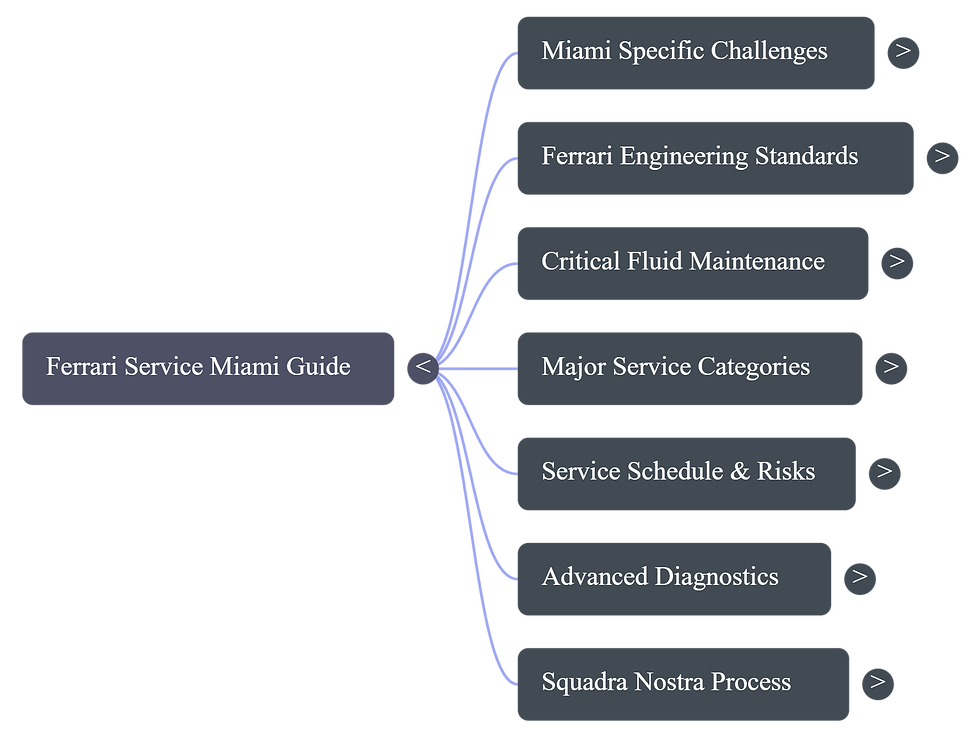
Ferrari service Miami is not something you can handle at any garage on the street. A Ferrari is one of the most precisely engineered machines that has ever been put into production. Every component is designed around performance targets and tolerances that demand a specific level of knowledge and care during service. Get it right and the car performs exactly as Ferrari intended for years. Get it wrong and the consequences are expensive and sometimes irreversible.
This guide covers Ferrari service in Miami in full detail. It explains what a Ferrari needs and why. It covers the oil specifications that Ferrari requires and why using the wrong product causes real harm. It walks through every major service category from the engine and transmission to the brakes and tyres. It gives you a complete service schedule with honest information about what happens when service items are skipped. And it explains what a high level service looks like when it is done properly by a team that actually knows these vehicles.
Squadra Nostra is Miami's specialist in exotic car service. Their team brings over 15 years of combined experience working on Ferrari and other exotic vehicles across Miami-Dade and Broward County. This guide is written from that real hands-on experience and it is designed to give every Ferrari owner in Miami the full picture of what proper care for these cars actually requires.

1. Ferrari Service Miami: Why This City Demands a Different Standard
Miami is not a typical city for exotic car ownership. The combination of year-round heat, humidity from the ocean, salt air near the coast and the general intensity of the environment creates conditions that affect vehicles differently from a cooler and drier location. For a Ferrari owner these conditions are not just background context. They are factors that directly influence how often certain service items need attention and how quickly certain components reach the end of their service life.
The heat in Miami is the first consideration. A Ferrari engine operating in an environment where the ambient air temperature is consistently high works harder to manage its own thermal output. The cooling system is under greater demand than it would be in a northern city. Oil reaches operating temperature faster and is exposed to higher sustained temperatures during use. Battery chemistry is affected by heat in ways that shorten service life. These are not minor details. They change the maintenance approach that a properly cared for Ferrari in Miami requires compared to the same car in a different climate.
The salt air near Miami Beach and Brickell creates a corrosive environment for exposed metal components. Brake rotors and calipers underneath the car are particularly exposed. Exhaust hardware that hangs in the underfloor environment is affected by salt air faster than in an inland location. The cars that live near the water need more frequent inspection of these components to catch early corrosion before it creates a failure or a safety concern.
Finding a service provider in Miami who understands all of this and who brings genuine Ferrari-specific knowledge to the job is the challenge that every Ferrari owner faces. This guide is designed to help you understand what proper service looks like so you can identify who is actually equipped to deliver it.
Squadra Nostra Note Ferrari owners in Miami who have previously used general mechanics often come to us after discovering that something was done incorrectly. Wrong oil grade. Incorrect brake pad compound on carbon ceramic rotors. Incomplete diagnostic scan. The pattern repeats because general shops lack the specific knowledge that Ferrari service requires. We built our entire operation around preventing this from happening. |
2. What Makes a Ferrari Different from Every Other Car You Have Owned
This is not just a marketing statement. A Ferrari is engineered to tolerances that mainstream vehicles do not come close to. Understanding what makes it different is the foundation of understanding why it requires specialist service.
The Engine
Ferrari engines are built to produce maximum power from a given displacement through extraordinary precision in the combustion process. Whether your Ferrari has the naturally aspirated V12 found in the 812 Superfast and the Purosangue, the twin-turbocharged V8 found in the F8 Tributo, the Roma and the SF90, or the flat-plane crank V8 in the 488 Pista, these are engines that operate at RPM ranges, compression ratios and thermal loads that mainstream engines are not designed for. They are assembled by hand with tolerances that are measured in fractions of a millimetre. They need fluids that match those tolerances exactly. They need service intervals that account for the stress they are placed under in normal use.
The Transmission
Most modern Ferraris use a dual clutch transmission system called the F1 DCT. This is an automated manual gearbox that uses two separate clutch packs to allow gear changes in fractions of a second. The dual clutch system is exceptional at what it does but it is complex and it requires specific fluid specifications and service intervals to remain reliable. It also has software that continuously adapts its clutch engagement maps based on use patterns. When service is neglected this software adaptation drifts and shift quality degrades in ways that feel like the transmission is wearing out when sometimes the correct service is all that is needed.
The Braking System
Ferrari braking systems are some of the most capable in any production vehicle. Many models offer carbon ceramic brake rotors as an option or as standard equipment. These rotors are extremely light have excellent fade resistance at high temperatures and can last a very long time when properly maintained. The critical point about carbon ceramic systems is that they require brake pads specifically formulated for use with carbon ceramic rotor material. Using standard iron-spec pads on a carbon ceramic rotor damages the rotor surface rapidly and in a way that cannot be repaired. Understanding this distinction is something that general mechanics frequently miss.
The Electronics
A modern Ferrari has a deeply complex electronic architecture that manages the engine the transmission the traction and stability systems the active aerodynamics on certain models and the magnetic ride control suspension. This system has multiple control modules each of which can store fault codes independently of the others. A diagnostic tool that accesses only the main engine management module misses the majority of what the car might be telling you. Proper Ferrari service requires equipment that accesses the full module range and software that can interpret what each module is reporting.
3. Why You Should Never Take a Ferrari to a General Mechanic
A general mechanic is trained to service a wide range of vehicles. That training is valuable for the vehicles it covers. But Ferrari is not in the category that general automotive training addresses. The gap between general mechanical knowledge and Ferrari-specific knowledge is wide and on a car of this engineering and value the gap costs money when someone without the right knowledge works on your car.
The most immediate risk is incorrect fluid specification. A general mechanic using a parts catalogue to find the oil for a Ferrari will find a grade recommendation that meets a broad standard. That broad standard is not what Ferrari specifies. Ferrari sets its own internal specifications for oil that go beyond standard SAE grades and API certifications. Using a product that meets general standards but not Ferrari's own specification means the engine is running on oil that was not designed for its operating characteristics. Over time this shows up as increased wear on components that are expensive to repair or replace.
The second risk is incomplete diagnostics. A standard OBD reader connected to a Ferrari will access a limited subset of the car's electronic systems. It will pull codes from the engine management module. It will not access the transmission control unit, the suspension control module, the stability management system, the active aerodynamic controllers or any of the other modules that make up the car's full electronic architecture. A service that does not include a complete multi-module diagnostic scan on a Ferrari is not a complete service.
The third risk is incorrect procedure on specialist components. Installing brake pads on a Ferrari with carbon ceramic rotors without knowing the correct pad compound for that rotor system damages the rotors. Working on the Ferrari DCT transmission without the correct software interface to read clutch wear data and perform actuator calibrations means the transmission is serviced blindly. These are not failures of effort. They are failures of knowledge that a specialist prevents by having worked on these systems many times before.
Important Warning for Ferrari Owners If you are looking at prices for Ferrari service and you see a quote that seems very low compared to what a specialist charges, ask what diagnostic system the shop uses and whether it accesses all Ferrari control modules. Ask what oil brand and specification they plan to use. Ask whether they use the correct pad compound for your brake system type. The answers to these questions will tell you everything about whether the shop is equipped to service your Ferrari correctly. |
4. What Oil Does a Ferrari Use and Why It Matters So Much
This is one of the most important topics in all of Ferrari service and one that is frequently handled incorrectly outside of specialist shops. Ferrari does not simply specify a standard SAE grade and allow any product meeting that grade to be used. Ferrari specifies their own internal oil standard. The oil used in a Ferrari must meet Ferrari's own approval specification which is separate from general industry certifications.
Ferrari's Own Oil Specification
Ferrari works with Shell as their official oil partner. The Shell Helix Ultra series is the approved product for Ferrari engines across their lineup. Specifically Shell Helix Ultra Professional AV 0W-20 is the approved grade for the turbocharged V8 engines found in the F8 Tributo, the Roma, the Portofino M and the SF90 Stradale. The naturally aspirated V12 in the 812 Superfast requires Shell Helix Ultra 5W-40. These specifications are not interchangeable between engine families and they are not substitutable with competing products that meet similar general standards without Ferrari's explicit approval.
The reason for this specificity is that the oil's viscosity, its additive package and its shear stability are all matched to the actual clearances, materials and operating conditions of the specific Ferrari engine it is approved for. The twin-turbocharged V8 operates at different temperatures and with different oil pressure requirements from the naturally aspirated V12. Using the V12 specification oil in a turbo V8 engine or vice versa creates a mismatch between the oil's designed operating range and the actual conditions it is experiencing.
What Happens When the Wrong Oil Is Used
The consequences of using incorrect oil in a Ferrari engine develop over time rather than appearing immediately. In the short term the engine may feel and sound no different. But the oil film thickness at the bearing surfaces, the oil's ability to remove heat from the combustion area and the rate at which the oil's additives deplete all depend on the oil being matched to the engine. An oil that is too thick for the engine's cold-start oil passages causes momentary starvation at the bearings during the first seconds after a cold start.
An oil that is too thin for the operating temperatures reached at high RPM cannot maintain adequate film thickness between moving surfaces. Both situations cause accelerated wear that accumulates invisibly until a component reaches the end of its life prematurely.
Ferrari Oil Specification Reference Table
Ferrari Model / Engine | Oil Specification | Service Interval |
Ferrari 812 Superfast / V12 6.5L | Shell Helix Ultra 5W-40 | Annually or per mileage |
Ferrari F8 Tributo / V8 TT 3.9L | Shell Helix Ultra Professional AV 0W-20 | Annually or per mileage |
Ferrari Roma / V8 TT 3.9L | Shell Helix Ultra Professional AV 0W-20 | Annually or per mileage |
Ferrari SF90 Stradale / V8 TT 4.0L | Shell Helix Ultra Professional AV 0W-20 | Annually or per mileage |
Ferrari Portofino M / V8 TT 3.9L | Shell Helix Ultra Professional AV 0W-20 | Annually or per mileage |
Ferrari 296 GTB / V6 TT 3.0L | Ferrari Approved Fully Synthetic 0W-20 | Annually or per mileage |
Ferrari Purosangue / V12 6.5L | Shell Helix Ultra 5W-40 | Annually or per mileage |
Ferrari 488 Pista / V8 NA 3.9L | Shell Helix Ultra Racing 10W-60 | More frequent on track use |
Oil Change Interval on a Ferrari
Ferrari specifies oil change intervals based on both mileage and time. Both triggers apply and whichever comes first is when the service is due. For Ferrari owners in Miami who drive their cars regularly in hot conditions the time-based interval is often as relevant as the mileage trigger because oil degrades chemically through heat cycles regardless of how far the car has travelled. Owners who drive their Ferrari infrequently should not delay oil service beyond the time interval even if the mileage is low. Old oil in a Ferrari engine that has been through many heat cycles without the fluid being replaced is degraded oil regardless of how few miles appear on the odometer.
5. Engine Service: What Happens Inside a Ferrari Engine During a Proper Service
A proper engine service on a Ferrari is not just draining the old oil and refilling with new. It is a structured inspection and maintenance process that addresses every part of the engine's supporting systems alongside the fluid change.
The Oil Service Process
The oil service begins with warming the engine to operating temperature which thins the oil and allows it to drain completely from all passages including the areas around the variable valve timing actuators. The drain plug is removed and the oil is collected for disposal. The drain plug washer is always replaced with a new unit. A used washer that has been crushed by the torque of the drain plug will not seal with the same reliability as a new washer even if it appears visually intact.
The oil filter on a Ferrari is not the same as a filter on a mainstream vehicle. Ferrari engines use high-capacity oil filters positioned to ensure complete oil pickup when the car is at extreme angles during cornering. The filter housing varies between models and some require specific tools to remove and reinstall correctly. The filter is replaced with a new genuine or OEM-equivalent unit and the housing is reinstalled to the correct torque specification.
After the new oil is filled to the factory specified quantity the level is checked using the car's own oil level sensor in the dashboard rather than with a dipstick, which most modern Ferraris do not have. The engine is started and run briefly, then the level is confirmed again after the oil has circulated and settled. The area around the drain plug and filter housing is inspected visually for any leaks before the service is considered complete.
What Else Is Checked During an Engine Service
A thorough engine service at Squadra Nostra includes a visual inspection of all visible fluid lines for any signs of seeping, weeping or oil mist around gasket surfaces. The air filter condition is checked and replaced if it shows signs of restriction. The spark plug condition is assessed visually even if they are not due for full replacement. The coolant level is checked and the coolant condition is noted for the cooling system service schedule. The engine bay is inspected for any loose connections, damaged heat shielding, or fluid contamination that needs to be addressed before the next service visit.
6. Transmission Service on a Ferrari Dual Clutch Gearbox
The Ferrari F1 DCT dual clutch transmission is one of the most impressive gearboxes ever fitted to a road car. It shifts faster than any human hand could manage and in sport and race mode it delivers a driving experience that is genuinely involving in a way that a traditional torque converter automatic cannot replicate. Keeping it in this condition requires its own specific service regime.
DCT Fluid Service
The dual clutch transmission uses its own dedicated fluid that is separate from the engine oil. This fluid lubricates the gear sets and provides the hydraulic pressure for the clutch actuation system. It is subjected to significant heat and pressure during normal use and more so during track driving or sustained high performance road use. Ferrari specifies a transmission fluid that is distinct from what a general parts supplier might recommend as a gearbox oil for this type of unit.
When DCT fluid degrades past its service life it loses its lubrication and hydraulic properties. The most noticeable early symptom is a slight coarsening of the shift quality. Upshifts under load feel less crisp. Downshifts produce a slight judder where they previously felt seamless. Low speed creeping in traffic becomes slightly jerky. These symptoms are often misdiagnosed as clutch wear when the actual issue is fluid that needs replacement. A fluid change on a Ferrari DCT with these symptoms frequently restores shift quality to a near-new standard without any mechanical repair being needed.
Clutch Adaptation and Calibration
The Ferrari DCT has software in the transmission control unit that continuously adapts its clutch engagement maps based on how the car is driven and the measured characteristics of the clutch packs. This adaptation process compensates for normal clutch wear over time. However if the transmission is serviced or if certain components are replaced the adaptation needs to be reset so the software can learn the new baseline. This reset requires the correct software interface connected to the transmission control module. A service that does not include this step after any transmission work leaves the gearbox operating on outdated adaptation data.
7. Brake Service on a Ferrari: Pads, Fluid and Carbon Ceramics
Ferrari brake systems are some of the most capable in production car history. The carbon ceramic brake option that is available on most current Ferrari models and standard on certain performance variants represents the state of the art in production car braking. Servicing these systems correctly is one of the areas where the difference between a specialist and a general mechanic is most consequential.
Brake Fluid Service
Brake fluid is hygroscopic. This means it absorbs moisture from the air over time. As the moisture content in the brake fluid increases the boiling point of the fluid decreases. In normal driving this rarely causes a problem because the brakes do not reach temperatures high enough to boil brake fluid with slightly elevated moisture content. But in a Ferrari that is driven with any enthusiasm the story is different. A single hard braking event from high speed generates enough heat in the brake system to boil fluid that has absorbed a meaningful amount of moisture. Boiling brake fluid creates gas bubbles in the hydraulic circuit and gas is compressible where fluid is not. The result is a pedal that travels further than expected or goes soft during exactly the moment when consistent braking force is most needed.
Ferrari recommends brake fluid replacement every two years as a minimum. In Miami's humidity where moisture absorption from the atmosphere happens faster than in a dry climate this interval is worth treating as a maximum rather than a baseline. A moisture content test of the brake fluid at each annual service takes moments and gives an accurate picture of whether the fluid needs replacement before the two year mark.
Standard Iron Brake Pads and Rotors
Ferrari models with standard iron rotors use performance grade pad compounds that are matched to the rotor material and the thermal operating range of the brake system. Replacing these pads with generic aftermarket compounds that meet a broad friction standard but are not matched to the Ferrari application is a performance compromise. The initial bite, the fade resistance at high temperatures and the pedal feel under repeated heavy braking are all affected by pad compound selection. Squadra Nostra uses correct specification pads for every Ferrari brake service.
Carbon Ceramic Brake System Service
The carbon ceramic brake system on a Ferrari is a completely different technology from iron disc brakes. The rotors are manufactured from a carbon fibre reinforced silicon carbide matrix that is extremely light, provides outstanding fade resistance at very high temperatures and under normal road use can last significantly longer than iron rotors. However the maintenance requirements are fundamentally different.
The single most important requirement for carbon ceramic brake service is using the correct pad compound. Carbon ceramic rotors require pads specifically formulated for use with carbon ceramic surfaces. These pads use a different friction material from standard iron-spec pads. Using iron-spec pads on a carbon ceramic rotor generates abrasive wear that rapidly destroys the rotor surface in a way that cannot be repaired. A set of carbon ceramic rotors on a Ferrari costs many times more than a set of iron rotors. The incorrect pad selection from a shop that does not know what they are looking at leads to an extremely expensive avoidable repair.
Carbon ceramic rotors should also be inspected for surface cracking at each service visit. Radial cracks of limited depth are a normal feature of carbon ceramic rotors that do not indicate a problem. Cracks that propagate beyond a certain depth or width, or circumferential cracks that form closed rings around the rotor, are a signal that the rotor needs replacement. Knowing what normal wear looks like on carbon ceramic versus damage that needs action requires having seen many of these rotors at different stages of their service life. This is experience that general mechanics simply do not have.

8. Cooling System Service and Why Miami Heat Makes This Critical
The cooling system in a Ferrari manages the engine's thermal output across all operating conditions. It circulates coolant between the engine block, the cylinder heads, the radiators in the front of the car and in many models additional heat exchangers for the engine oil and the transmission fluid. The system has to maintain the engine within a specific temperature window under all conditions from slow city traffic in 90 degree Miami heat to sustained high RPM driving on the motorway.
Coolant contains a two-part function. It transfers heat away from the engine and into the radiators where the heat is released into the air. It also contains corrosion inhibitors that protect the aluminium surfaces throughout the cooling circuit from oxidation and electrochemical attack. These inhibitors deplete over time. Old coolant that has depleted its inhibitor package begins to attack the aluminium it is circulating through which causes surface oxidation, blockages in small coolant passages and in severe cases corrosion of the water pump impeller and the radiator core.
Ferrari recommends coolant replacement every three years as a minimum. In Miami's conditions where the cooling system works harder than in cooler climates, this interval is one that should be followed precisely rather than extended. The pressure test that accompanies a coolant service checks every connection in the cooling circuit for early signs of leaking. A small leak that is not causing visible symptoms at ambient pressure may open under the system pressure created during operation and cause a significant coolant loss event. Catching a small leak during a routine pressure test prevents a roadside overheating incident.
The thermostat function is checked during a cooling system service. A thermostat that is stuck open causes the engine to run below its optimal temperature which increases fuel consumption and wear from incomplete combustion at cold running temperatures. A thermostat that is stuck closed or opening late causes the engine to run hot which triggers the cooling fan systems but in severe cases can cause overheating damage before the driver is aware there is a problem.
9. Electrical System and Battery Maintenance on a Ferrari
Modern Ferraris are electronically complex vehicles. The number of control modules that manage different systems and the interdependence between those systems means that electrical health is directly relevant to how the car performs across every operational area. Battery maintenance and electrical system health are service items that Ferrari owners sometimes underestimate in importance.
Battery Health in Miami's Climate
The battery in a Ferrari powers the start sequence and maintains the memory and clock functions across all control modules when the car is not running. In Miami's climate where ambient temperatures are consistently high the chemical degradation that occurs inside a battery cell happens faster than in a cooler environment. A Ferrari battery that appears to be functioning normally can be approaching the end of its reliable service life without showing obvious symptoms in everyday use. The first indication is often a slow crank speed on a hot start or a delayed response when the start button is pressed.
A Ferrari that sits unused for extended periods without a battery maintainer connected gradually drains its battery through the continuous low level current draw of the vehicle's electronic systems. When the battery voltage drops below a threshold the control modules lose their stored data and some modules reset to default states that require recalibration. Battery maintainers, also called trickle chargers or conditioners, are devices designed to keep the battery at full charge without overcharging it during storage periods. Every Ferrari owner who does not drive their car daily should have one connected when the car is not in use.
Charging System Service
The alternator charges the battery during driving and provides current for all electrical systems while the engine is running. An alternator that is underperforming does not always trigger a dashboard warning immediately. It may show up first as a battery that drains faster than expected, as repeated battery fault codes when the car is scanned, or as electrical system behaviour that seems inconsistent. Squadra Nostra's starting and charging system service includes output testing of the alternator to confirm it is delivering the correct voltage and amperage across the operating RPM range.
10. Tyre Service and Geometry on a Ferrari
Tyres on a Ferrari are the only connection between the car and the road. Everything the car does in terms of acceleration, braking and cornering depends on four contact patches that are each roughly the size of a hand. The condition and setup of those tyres determines how the car feels and how safely it responds at the performance levels these cars are capable of.
Ferrari models are typically fitted with Pirelli tyres developed specifically for each model through Pirelli's P Zero range including the Corsa variant for track-focused cars. These tyres are engineered in cooperation with Ferrari to complement the specific chassis and suspension tuning of each model. Using a different tyre brand that meets the dimensional specification but was not developed for the car's specific setup is a compromise that may feel acceptable in normal driving but that will not deliver the same response at the performance limits the car was tuned around.
Tyre pressure is a service item that many Ferrari owners do not pay enough attention to. The pressures Ferrari specifies for road and track use are different from each other and both are different from the pressures that the car shipped with on its delivery. Running incorrect pressure affects the size of the contact patch the tyre presents to the road, the temperature distribution across the tyre width during use and the rate at which the tyre wears. Checking and correcting tyre pressure with cold tyres before each drive is the single simplest maintenance task that has a direct effect on how the car performs and how long the tyres last.

Wheel alignment and suspension geometry on a Ferrari should be checked at least annually or after any impact event regardless of whether visible damage was caused. Ferrari's chassis is tuned around specific geometry targets for camber, caster, toe and ride height at each corner. Running outside those targets causes uneven and accelerated tyre wear, changes the car's handling balance and in some cases creates safety issues at the performance limits. A proper four wheel alignment on a Ferrari requires the correct reference data for the specific model and the correct measurement equipment to set it accurately.
11. Annual Diagnostic Scan: The Most Underrated Ferrari Service
Every Ferrari service should begin with a full multi-module diagnostic scan. This is the step that many general mechanics skip entirely because their tools cannot access more than a fraction of what a Ferrari's electronic architecture contains. It is also the step that provides the most valuable information about the actual health of the vehicle before any physical work begins.
A complete diagnostic scan of a Ferrari accesses the engine management module, the transmission control unit, the F1-trac stability control system, the E-diff electronic differential controller where fitted, the ABS module, the suspension control module on models with magnetic ride control, the body control module that manages doors and windows, the active aerodynamic controllers on models with moveable aero elements, the infotainment and instrument cluster modules and any other modules in the car's electronic network.
Each of these modules stores fault codes independently. A code stored in the stability control module does not appear in a scan that only reads the engine management system. A fault in the electronic differential controller can cause handling behaviour that an owner notices but that a partial diagnostic never finds because the tool used was not accessing that module. This is the reason why full coverage diagnostic equipment is non-negotiable for proper Ferrari service.
Squadra Nostra performs a complete multi-module diagnostic scan at the start of every Ferrari service visit. The report is documented and the owner receives a full picture of every fault code stored in every module before any service work begins. This baseline tells the service technician what to focus on and tells the owner exactly what the car's electronics are reporting, with photo documentation to support every finding.
12. When Should You Service Your Ferrari in Miami
The right time to service a Ferrari is determined by two triggers that operate independently. The first is mileage and the second is time. Ferrari sets intervals for both and whichever trigger is reached first determines when the service is due.
For Ferrari owners who drive regularly the mileage trigger is usually reached first. For owners who use their Ferrari less frequently the time trigger applies. A Ferrari that sits in a garage and covers only a small number of miles per year still needs an annual service because oil degrades over time regardless of miles, brake fluid absorbs moisture regardless of miles, and the battery requires attention regardless of how little the car is driven.
In Miami's climate there are specific moments when a Ferrari service is particularly important regardless of the standard schedule. Before summer is a good time for a cooling system check because the highest ambient temperatures of the year are approaching and any weakness in the cooling system will be tested most severely in June, July and August. After any track day is the right time for an inspection because track use puts greater stress on the oil, the brakes and the tyres than any amount of road driving. And before any long road trip is a good time for a full check because a Ferrari that has a developing fault is less likely to create a problem in Miami where help is nearby than it is on a highway far from the city.
13. The Full Ferrari Service Schedule with What Happens If You Skip
This table gives you the complete picture of what every Ferrari service item involves and the real consequences of deferring or skipping it.
Service Item | When to Do It | What Happens If You Skip |
Engine Oil and Filter | Annually or per Ferrari mileage interval | Accelerated engine wear from degraded lubrication. Sludge in oil passages over time. Eventually expensive engine damage. |
Multi-Module Diagnostic Scan | Every service visit | Developing faults go undetected. Small issues become expensive failures because they were not caught early. |
Spark Plugs | Per Ferrari service interval for the specific model | Incomplete combustion at all RPM. Misfires at high RPM. Unburned fuel reaching catalytic converters shortening their life. |
Air Filter | Annually or by condition in Miami's environment | Reduced airflow to the engine. Less power. Richer running condition. Increased fuel consumption. |
Brake Fluid Replacement | Every two years or when moisture test indicates | Risk of brake fade under hard use. Soft pedal at the worst possible moment. Safety concern in Miami's humidity. |
Brake Pads Inspection and Replacement | By measured wear at each service | Metal-on-metal contact with rotors if pads reach minimum thickness. Expensive rotor damage from pad wear through. |
Carbon Ceramic Rotor Inspection | Every service visit | Missed cracks that propagate to failure. Undetected surface damage from incorrect pad usage by a previous service. |
DCT Gearbox Fluid | Per Ferrari interval or more frequently with track use | Degraded shift quality. Clutch wear accelerated by inadequate lubrication. Expensive DCT rebuild in severe cases. |
Coolant Replacement | Every three years or as Ferrari specifies | Loss of corrosion inhibitor protection. Internal aluminium corrosion. Cooling system blockages. Overheating risk. |
Cooling System Pressure Test | Every major service | Undetected small leaks develop into coolant loss events. Overheating causes gasket failure and warped heads. |
Battery Health Test | Annually | Unexpected failure to start. Voltage drop triggering fault codes across multiple modules. Module resets requiring recalibration. |
Tyre Pressure Check | Monthly minimum. Before every track day. | Incorrect contact patch. Uneven tyre wear. Handling imbalance. Premature tyre failure at the performance limit. |
Tyre Tread and Condition | Every service visit | Wet weather grip reduced. Structural tyre failure risk increases as tread wears beyond safe limits. |
Wheel Alignment and Geometry | Annually and after any impact | Rapid and uneven tyre wear. Handling that does not match the car's design. Instability at performance limits. |
Drive Belt Inspection | Per Ferrari service interval | Belt failure stops the engine and leaves you stranded. In some configurations a failed belt causes engine damage. |
Fuel Filter | Per Ferrari service interval | Restricted fuel flow at high demand. Injector contamination. Hesitation and power loss at high RPM. |
Cabin Air Filter | Annually in Miami's environment | Reduced airflow to climate control. Restricted cabin ventilation. Affects AC performance in Miami's heat. |
14. What a High Level Ferrari Service Looks Like from Start to Finish
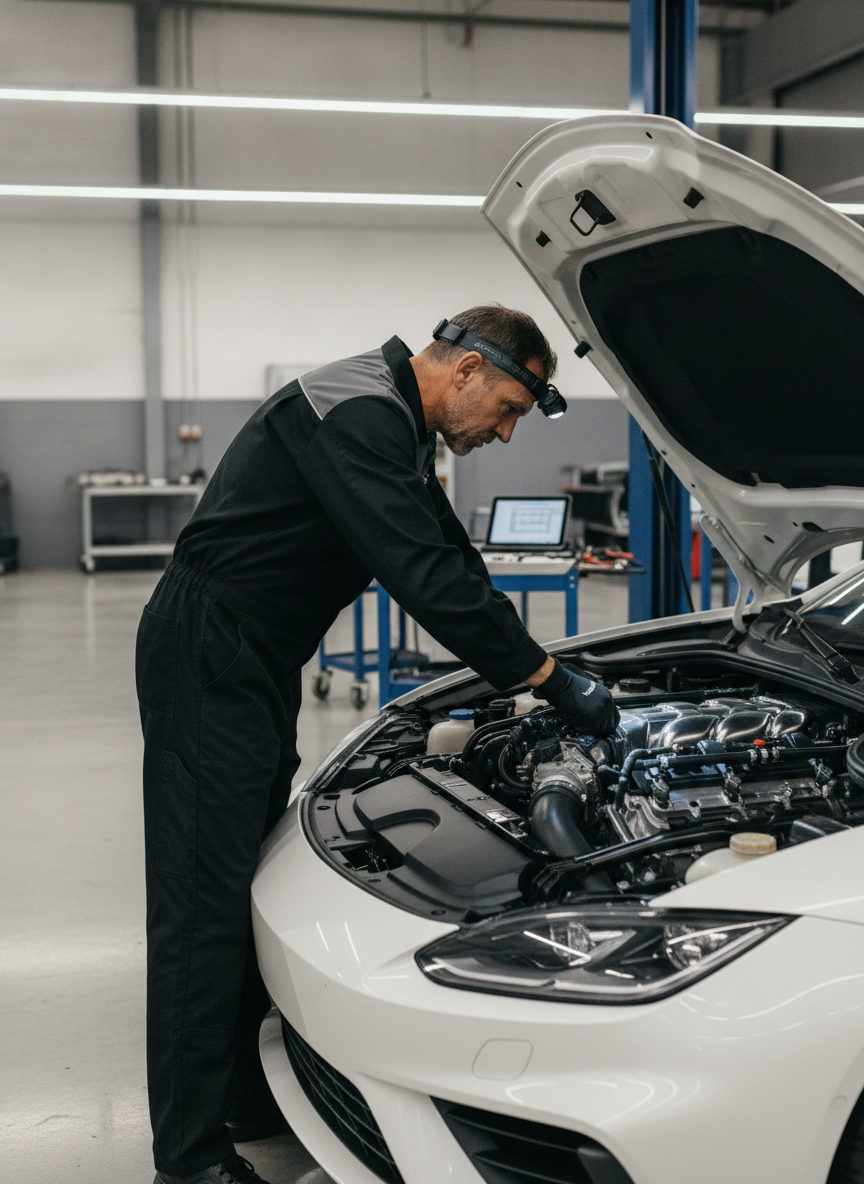
A high level Ferrari service is not a single task. It is a structured process that moves through a complete inspection, assessment and service sequence before the car leaves the technician's hands. This is what that process looks like when it is done to the standard that a Ferrari deserves.
Stage One: Pre-Service Multi-Module Diagnostic
The service begins before any spanner is turned. The diagnostic system is connected and a full scan of all control modules produces a report of every stored fault code across the car's complete electronic network. This report is documented with the fault descriptions and severity levels of each code. The owner is walked through this report so they understand the car's current electronic health and what if anything needs attention beyond the scheduled service items.
Stage Two: Visual Inspection of All Major Systems
With the diagnostic picture established a physical inspection follows. The engine bay is inspected for any oil misting, coolant weeping, loose connections or damaged components. The underfloor of the car is inspected for any leaks, damage to heat shielding, corrosion on brake components and the condition of exhaust hangers and connections. The brake pads are measured for remaining thickness at each corner. The tyres are inspected for tread depth and condition across the full tread width. All findings from this inspection are photographed and documented.
Stage Three: Fluid Services
Oil and filter are replaced using the correct Ferrari specification fluid. The brake fluid is tested for moisture content and replaced if indicated. The coolant level and condition are checked and the system is pressure tested. The DCT transmission fluid is assessed and replaced if the service interval or fluid condition indicates. Any other fluid services due for the specific model and mileage are completed during this stage.
Stage Four: Component Services and Replacements
Spark plugs, air filter, cabin filter and any other components that are due for replacement based on mileage or condition are addressed during this stage. Brake pads that have reached their wear indicator threshold are replaced with the correct specification compound for the brake system type. Any consumable components identified during the inspection stage that need attention are completed here.
Stage Five: Software and Calibration Checks
Any fault codes that were found during the initial diagnostic scan are addressed at this stage. Adaptation resets on the DCT transmission are performed if the fluid was changed. Any module calibrations that were disturbed by service work are corrected using the appropriate software interface. The diagnostic system is reconnected for a final full scan to confirm all fault codes have been addressed and no new codes have been generated by the service work.
Stage Six: Final Inspection and Documentation
The completed service is reviewed against the initial inspection and diagnostic findings to confirm everything identified at the start has been addressed. The owner receives a complete service record including the pre-service diagnostic report, all photographs taken during the inspection, the parts replaced with the specifications used, and recommendations for any items that need monitoring before the next service visit.
15. Ferrari Service at Your Location: Mobile Service in Miami
Squadra Nostra delivers Ferrari service directly to the owner's location. The technician comes to your home, office, private garage or any other accessible location with all of the necessary equipment to perform a complete Ferrari service. This includes the diagnostic system that accesses all Ferrari control modules, the correct fluids and components for the specific model, and the professional tools required for each service task.
The mobile model works particularly well for Ferrari owners because it removes the need to drive a car with a developing fault to an unfamiliar location, to leave a six-figure vehicle with people you have not fully vetted and to arrange alternative transport for the time the car is away. The service comes to you, you remain with the vehicle and you can see exactly what is being done at every stage.
Squadra Nostra serves Ferrari owners across Miami-Dade and Broward County including Brickell, Coconut Grove, Coral Gables, Miami Beach, Aventura, Bal Harbour and surrounding areas. Their team is available Monday through Friday from 8 AM to 8 PM and Saturday through Sunday from 10 AM to 6 PM. Appointments can be booked online at squadranostra.com or by calling 305-250-9853.
16. How Squadra Nostra Handles Ferrari Service in Miami
Squadra Nostra is built around the principle that exotic vehicles deserve service at the level their engineering demands. Their team brings over 15 years of combined experience with Ferrari and other exotic vehicles. This experience is the foundation of everything they do and it is what separates their approach from a general mechanic who occasionally works on an exotic car.
Every Ferrari service at Squadra Nostra follows manufacturer-correct standards. The correct oil specification for the specific model is always used. The correct diagnostic system is always connected before any work begins. The correct pad compound is always verified before any brake service. The correct torque specifications are applied to every fastener. These things sound like they should be obvious but in the context of Ferrari service in Miami they represent a standard that many available service providers do not consistently meet.
The service documentation that Squadra Nostra provides is comprehensive. Photo and video evidence of every finding and every completed service item gives the owner a record that is genuinely useful for tracking the car's condition over time and for demonstrating proper service history to a future buyer. For Ferrari owners who care about maintaining the value of their investment alongside the performance and reliability this documentation is part of the service value.
Contact Squadra Nostra through squadranostra.com, by calling 305-250-9853 or by email at info@squadranostra.com. A complimentary diagnostic is available for new clients as the starting point for any Ferrari service relationship.
17. Final Thoughts on Ferrari Service in Miami
Ferrari service in Miami done properly is how a remarkable car stays remarkable. The engineering that went into building your Ferrari was extraordinary. The service it receives needs to match that level of attention. A Ferrari that is maintained correctly with the right fluids at the right intervals by technicians who understand the specific systems they are working on performs exactly as Ferrari intended for years. A Ferrari that is handed to someone without the knowledge to do the job correctly accumulates small problems that become large and expensive ones.
If you own a Ferrari in Miami there is no better starting point than a conversation with Squadra Nostra. The team knows these cars at a level that comes only from years of focused experience and they deliver their service in a way that is genuinely convenient for owners who value both their time and their vehicles. Reach out through squadranostra.com or call 305-250-9853 today.

Frequently Asked Questions About Ferrari Service in Miami
These are the questions Ferrari owners in Miami ask most often about keeping their cars properly maintained.
FAQ 1: How often should I service my Ferrari in Miami?
Ferrari sets service intervals based on both mileage and time and whichever is reached first triggers the service. For most owners in Miami who drive regularly the annual service is the practical baseline. Owners who drive their Ferrari less frequently still need annual service because oil degrades chemically over time regardless of mileage, brake fluid absorbs moisture regardless of mileage and the battery needs attention regardless of how little the car is driven. Track use shortens oil and brake fluid intervals regardless of the standard schedule.
FAQ 2: What oil does a Ferrari use and where do I get it?
Ferrari specifies Shell Helix Ultra products for their lineup. The specific grade depends on the engine. Turbocharged V8 models including the F8 Tributo and the Roma use Shell Helix Ultra Professional AV 0W-20. The naturally aspirated V12 in the 812 Superfast and the Purosangue uses Shell Helix Ultra 5W-40. The 488 Pista with its performance V8 uses Shell Helix Ultra Racing 10W-60. Squadra Nostra sources the correct specification for each Ferrari model they service. Using a product that meets general standards but not Ferrari's own specification is not adequate.
FAQ 3: Can I take my Ferrari to a regular mechanic in Miami?
You can but it carries real risk. The most common consequences are incorrect oil specification, incomplete diagnostic scan, incorrect brake pad compound on carbon ceramic systems and incorrect procedures on the DCT transmission. Each of these produces either performance degradation or accelerated component wear that shows up as expensive repairs later. The cost of correct specialist service is significantly less than the cost of correcting the mistakes that general mechanics make on Ferraris.
FAQ 4: How much does Ferrari service cost in Miami?
Ferrari service cost depends on which items are due, the specific model and whether any issues are found during the diagnostic scan. An annual service that includes an oil and filter change, multi-module diagnostic, brake fluid test and general inspection is the baseline. Services that include spark plugs, DCT fluid, coolant replacement and additional components cost more. Squadra Nostra provides a clear cost picture for each specific vehicle before any work begins.
FAQ 5: What is the difference between Ferrari carbon ceramic brakes and standard brakes?
Carbon ceramic brake rotors are made from a carbon fibre reinforced silicon carbide composite. They are significantly lighter than iron rotors, they resist brake fade much better at high temperatures and under normal road use they can last a very long time. The critical maintenance difference is that carbon ceramic rotors require brake pads specifically formulated for carbon ceramic surfaces. Standard iron-spec pads used on carbon ceramic rotors cause rapid and irreversible damage to the rotor surface that requires very expensive replacement. Every Ferrari brake service at Squadra Nostra verifies the rotor type before any pad is ordered or installed.
FAQ 6: Can Squadra Nostra come to my home in Miami for Ferrari service?
Yes. Squadra Nostra's service is fully mobile. The technician comes to your home, office, private garage or any accessible location in Miami with all of the necessary equipment for a complete Ferrari service. The quality and completeness of the service is identical to a workshop environment. There is no reduction in what can be accomplished by servicing the car at your location rather than taking it to a shop.
FAQ 7: Does Ferrari service at a non-dealer shop affect my warranty?
Under US law manufacturers cannot void a warranty simply because an independent shop performed the service unless they can demonstrate that the independent service caused a specific fault. Ferrari owners who use a specialist who follows Ferrari's own service specifications and uses approved fluids and components reduce the practical risk of any warranty friction. Squadra Nostra advises clients on warranty considerations specific to their vehicle before undertaking any service work.
FAQ 8: How do I know if my Ferrari needs an out-of-schedule service?
Trust what the car tells you. Any dashboard warning light should be investigated promptly rather than ignored. Any change in engine sound especially unusual noises on startup or at high RPM should be assessed immediately. Any change in how the gearbox shifts including a coarser shift quality or jerky engagement at low speed is worth a service visit. Any reduction in brake pedal feel or any smell from the brakes after use should be investigated. And if you have done a track day the car warrants a full inspection before returning to regular road use.
FAQ 9: Why does a Ferrari need a specialist diagnostic tool not a standard OBD reader?
A Ferrari's electronic architecture contains many control modules that a standard OBD reader cannot access. The standard tool reads the engine management module and nothing else. A Ferrari service scan needs to access the transmission control unit, the stability and traction control modules, the suspension controller, the electronic differential, the body control module and active aerodynamic controllers where fitted. Missing any of these means missing fault codes that may be pointing to developing issues in critical systems. Squadra Nostra's diagnostic equipment accesses the full Ferrari module network.
FAQ 10: What is the biggest mistake Ferrari owners make with service?
Trusting the wrong shop. The second biggest mistake is ignoring the time-based service interval because the mileage is low. Many Ferrari owners drive their cars infrequently and assume that low mileage means the service can wait. Oil degrades regardless of mileage. Brake fluid absorbs moisture regardless of mileage. A battery in a car that sits undriven in Miami's heat deteriorates regardless of mileage. The time interval exists precisely for these owners and it should be followed as carefully as the mileage interval.
FAQ 11: How does Miami's climate specifically affect my Ferrari?
The heat accelerates battery degradation and oil thermal degradation. The humidity accelerates brake fluid moisture absorption and creates conditions where certain rubber components and seals age faster. The salt air near the water creates a mildly corrosive environment that affects exposed brake components and exhaust hardware under the car. The combination means that a Ferrari kept and driven in Miami needs certain service items more frequently than the same car in a cooler drier inland city. Squadra Nostra's service approach accounts for these Miami-specific conditions at every visit.
FAQ 12: How do I book a Ferrari service with Squadra Nostra in Miami?
Visit squadranostra.com to book online or call 305-250-9853. You can also email info@squadranostra.com. The team operates Monday through Friday from 8 AM to 8 PM and Saturday through Sunday from 10 AM to 6 PM. When you make contact describe your Ferrari model and year, the approximate mileage, the last service date if you know it, and any specific concerns or symptoms you have noticed. A complimentary diagnostic is available for new clients as a starting point.
How-To Guide: Booking Your Ferrari Service in Miami with Squadra Nostra
If you want to get your Ferrari properly serviced in Miami and you have not used Squadra Nostra before, here is exactly how the process works from your first contact to the completed service.
Step 1: Gather Your Ferrari's Service History
Before you contact Squadra Nostra gather whatever service documentation you have for the car. Previous service invoices, the Ferrari service book if you have it, any diagnostic reports from previous service visits and the owner's manual with the maintenance schedule section. If you bought the car recently and have no service history, note that fact clearly because a car with unknown service history needs a more comprehensive initial assessment than one with a documented record.
Step 2: Note Any Symptoms or Dashboard Messages
Write down anything you have noticed about the car that is different from normal. Any warning messages that have appeared in the instrument cluster. Any sounds that are new or unusual. Any change in how the gearbox engages or shifts. Any variation in brake pedal feel. Any unusual smell from the engine bay or after braking. Write these down before you call so you can describe them accurately when speaking with the team.
Step 3: Contact Squadra Nostra
Call 305-250-9853 to speak with the team directly. You can also visit squadranostra.com to book online or email info@squadranostra.com. Tell them your Ferrari's model and year, the approximate mileage, the last service date if you know it and any symptoms from your notes in Step 2. The team will advise on whether to start with a diagnostic only visit or whether the mileage and time since last service suggest a full service is the right starting point.
Step 4: Confirm Your Location and Appointment Time
Squadra Nostra comes to you. Confirm the address where the car will be during the service. Make sure the car is accessible and that there is adequate space around it for the technician to work. Choose a time within their operating hours that fits your schedule. Allow adequate time for the service. A comprehensive Ferrari service including all staged steps takes several hours. Do not book anything else that requires the car during the appointment window.
Step 5: Be Present for the Pre-Service Diagnostic Walk-Through
When the technician arrives be present for the first part of the visit. The technician will connect the diagnostic system and run the full multi-module scan before touching anything else. Once the report is generated they will walk you through the findings. This is the moment when you get the full picture of your Ferrari's current electronic health. Ask questions. Make sure you understand what each finding means and what the recommended response is.
Step 6: Review and Approve the Service Plan
After the diagnostic walk-through the technician will present a service plan based on the diagnostic findings and the scheduled maintenance items that are due. Review this carefully. Understand the priority of each item. Ask which items need immediate attention and which can be monitored over time. Approve the work you want done at this visit and the technician will proceed accordingly.
Step 7: Receive Your Complete Service Documentation
When the service is complete you receive full documentation. This includes the pre-service diagnostic report with all fault codes found. Photographs of any findings that were discovered during the physical inspection. A record of every fluid changed with the specification used. A record of every component replaced. And recommendations for the next service visit and anything that should be monitored between now and then. Keep this documentation in a dedicated file for the car. It is part of the car's history and it adds value to the vehicle as a record of correct specialist maintenance.
Step 8: Ask About the Next Service Date
Before the technician leaves confirm when the next service is due. Based on your current mileage and the date of this service the technician can advise on when the next annual service or the next mileage-triggered service will fall due. Schedule it in your calendar now rather than waiting until you are reminded by a dashboard warning. Proactive Ferrari service in Miami means you stay ahead of the maintenance schedule rather than reacting to it.



Comments