


Lamborghini Supercharger: The Deep Guide to Adding Real Power
Lamborghini supercharger is a search that owners run when they have fallen in love with their car and want more of it. Not a different car. More of the same one. That is an important distinction, and it is the reason a supercharger is often the right answer on these engines when a turbo kit is not.
Here is why. A Lamborghini V10 is naturally aspirated. It breathes on its own, it revs high and it responds to your right foot instantly. That instant response is a huge part of why the car feels alive. A supercharger adds serious power while keeping that feeling. A turbo can take it away.
We are Squadra Nostra. We look after exotic and performance cars across Miami-Dade and Broward County, and we come to you. This guide is the honest version of the supercharger conversation. How it works, what a real kit includes, what Miami heat does to it and where builds go wrong.

Table of Contents
1. What a Supercharger Actually Does
A supercharger is an air pump. That is the whole idea. It forces more air into the engine than the engine could pull in on its own. More air means you can burn more fuel, and burning more fuel makes more power. Everything else is detail.
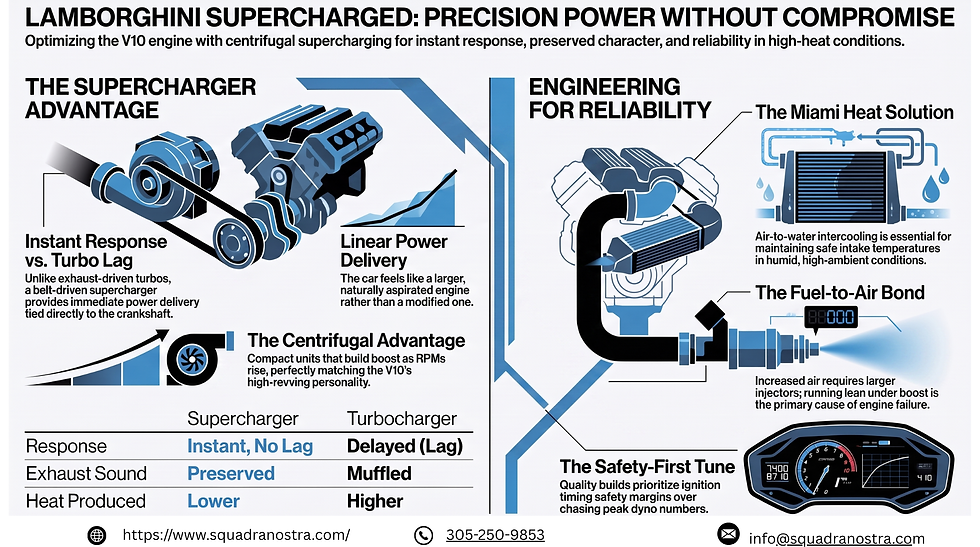
The key point is how it is driven. A supercharger is connected to the engine by a belt. When the engine spins, the supercharger spins. There is no waiting and no delay. The moment you press the throttle, the pump is already working, because it is physically tied to the crankshaft.
This is the whole reason superchargers suit a Lamborghini so well. The car already responds instantly. A belt driven pump keeps that. You press the pedal and the power is simply there, right now, exactly like the naturally aspirated car but with a lot more of it.
Squadra Nostra Perspective The best supercharged Lamborghini builds we have driven do not feel modified. They feel like a bigger, angrier version of the factory car. That is the goal. You should not be aware of the supercharger as a separate thing bolted on. You should just notice that the engine got a lot stronger and kept every bit of its personality. |
2. Why Lamborghini Owners Choose a Supercharger
Most owners who call us about a supercharger are not unhappy with their car. That surprises people. They love it. They just want more, and they do not want to lose what they already have in the process.
A Lamborghini V10 has a very specific personality. It revs hard, it sounds incredible at the top, and it answers your foot with no delay. Owners are protective of that. They have driven turbo cars and felt the pause before the shove, and they did not like it on a car that is supposed to feel connected.
A supercharger solves this. You keep the linear power delivery. You keep the throttle response. You keep the high rev character. And the car pulls harder everywhere. It is more of what you already loved, which is exactly what most owners are actually asking for even when they say they just want power.
3. Supercharger vs Turbocharger
This is the first real decision and it deserves a straight answer. Both add power by forcing in air. They just do it differently, and that difference changes how the car feels to drive.
A turbo is driven by exhaust gas. It has to wait for the engine to make exhaust before it can make boost, which creates lag. It also sits in the exhaust path, which muffles the sound. A supercharger is driven by a belt, so it responds instantly and it leaves the exhaust alone.
Feature | Supercharger | Turbocharger |
Driven by | Engine belt | Exhaust gas |
Response | Instant, no lag | Some lag |
Power delivery | Linear and predictable | Comes on in a rush |
Peak power potential | High | Higher |
Effect on exhaust sound | Keeps it | Muffles it |
Heat produced | Less | More |
Feel | Like a bigger engine | Like a different engine |
A supercharger costs you a little power to run, because the belt is stealing some engine energy to spin the pump. That is called parasitic loss and it is real. But you gain instant response and a car that still feels like a Lamborghini. For most owners on the street, that trade is easy.
Expert Note: Ask What You Actually Want If you want the biggest possible number for a drag strip, a turbo setup will get you there. If you want a car that is savage on a Miami road and still feels like the Lamborghini you fell in love with, a supercharger is usually the better answer. Neither is wrong. But be honest with yourself about which car you want to own. |
4. The Three Types of Supercharger
Not all superchargers work the same way. There are three main types and each behaves differently. Understanding them explains why Lamborghini kits almost always use one specific kind.
Roots
The classic style. It uses two rotors that push air through. It makes strong boost right off idle, which is why it is popular on big American V8 muscle cars. It is also physically large and it usually sits on top of the engine. That size becomes a problem on a mid engine supercar.
Twin Screw
A more advanced design that squeezes the air as it moves it, which makes it more efficient than a Roots. It also builds boost low down. Like the Roots, it is a big unit that wants to sit on top of the engine, and that space simply does not exist behind a Lamborghini's seats.
Centrifugal
This one looks and works like a turbo, but it is spun by a belt instead of exhaust gas. It uses an impeller to compress air. Boost rises as engine speed rises, so it builds power the higher you rev. It is compact, and it can be mounted where there is room rather than on top of the engine.

5. Why Centrifugal Wins on a Lamborghini
There are two reasons, and both are practical rather than theoretical.
The first is space. A Lamborghini V10 sits in the middle of the car in a tight engine bay, often under glass. There is no room to stack a large Roots or twin screw unit on top of it. A centrifugal unit is compact and can be mounted to the side, driven by a belt run to it. It is the only design that physically fits well.
The second reason is better than the first. A centrifugal supercharger makes more boost the harder you rev. A Lamborghini V10 loves to rev. Those two facts fit together perfectly. The power builds as the engine climbs, so the car pulls harder and harder all the way to the top. It matches the engine's personality instead of fighting it.
Expert Note: The Design Matches the Engine This is one of those cases where the practical answer and the ideal answer are the same. Centrifugal fits the space and it also suits how a V10 makes power. Boost climbing with revs on an engine that already wants to rev gives you a top end pull that is genuinely addictive. It is the right tool for this exact job. |
6. The V10 Engine You Are Building On
Before you add anything, understand what you are working with. The Lamborghini V10 is a naturally aspirated engine that revs past eight thousand. It was engineered to make its power at high revs by breathing efficiently, not by being forced.
That is important because it means the engine was never designed with boost in mind. The internal parts were chosen for a naturally aspirated life. This is not a weakness. It just means the amount of boost the engine can safely handle has a real limit, and a good builder respects that limit instead of pretending it does not exist.
This is why the honest supercharger conversation starts with a modest, safe boost level. A quality kit at a sensible power level can be very reliable on stock internals. Push far past that and you are now talking about a built engine with forged parts, which is a completely different project and a completely different budget.
7. Model Guide: Gallardo, Huracan and Aventador
Not every Lamborghini is the same platform. Here is how the main ones fit into this conversation.
Gallardo
The Gallardo has been supercharged for years and the aftermarket for it is mature and well proven. It is the platform where a lot of this development happened. Kits are well understood here, and a good supercharged Gallardo is one of the great value performance cars in the exotic world.
Huracan
The Huracan uses a naturally aspirated V10 and it is the most popular supercharger platform in the range today. It is newer, the electronics are more advanced and the aftermarket support is strong. Most of the calls we get about Lamborghini superchargers in Miami are about this car.
Aventador
The Aventador uses a naturally aspirated V12. It is a bigger, different engine in a bigger car. Forced induction on an Aventador exists but it is a more specialized world, and twin turbo setups are more common here than superchargers. The conversation changes on this platform.
Urus
Worth mentioning to avoid confusion. The Urus is already turbocharged from the factory, so it is not a supercharger candidate. If you want more from a Urus, the path is tuning and supporting hardware, not adding a blower.
8. What a Complete Kit Includes
People picture a supercharger as one part in a box. It is not. A real kit is a system, and every part of it exists because the others need it. Here is what a proper kit actually contains.
● The supercharger unit itself, which is the air pump.
● A mounting bracket that holds it correctly on the engine.
● A belt drive system to spin it from the crankshaft.
● An intercooler system to cool the compressed air.
● Piping to move air from the supercharger to the engine.
● Larger fuel injectors and often a fuel pump upgrade.
● A custom tune written for the whole package.
● All the hardware, hoses and small parts to make it work.
Notice that the supercharger is one item on a list of eight. That is the honest picture. A kit that skips the fuel side or ships without a proper tune is not a kit. It is a box of parts that will damage your engine, and no price is low enough to make that a good deal.
Warning: A Blower Without Fuel Is a Broken Engine More air must be matched with more fuel. If the fuel system cannot keep up, the engine runs lean under boost, and lean means heat and detonation. That is how pistons die. Any supercharger conversation that does not immediately include injectors and fuel supply is a conversation with the wrong shop. Walk away. |
9. Intercooling and the Miami Heat Problem
This is the section that matters most in our city, and it is the one owners underestimate every single time.
When you compress air, it gets hot. That is basic physics and there is no way around it. So the air leaving your supercharger is hot before it ever reaches the engine. Hot air is thin, so it carries less oxygen, which costs you power. Worse, hot air raises cylinder temperature, which pushes the engine toward detonation.
An intercooler is a radiator for that compressed air. It sits between the supercharger and the engine and pulls the heat back out before the air goes in. On a supercharged car, the intercooler is not an accessory. It is the part that makes the whole thing safe and it is doing critical work every second you are on the throttle.
Air to Air vs Air to Water
An air to air intercooler uses outside air passing through it to cool the charge. It is simple and light, but it needs airflow, which a mid engine car in traffic does not have much of. An air to water system uses a coolant loop with its own radiator and pump, and it is far less dependent on the car moving.
For a mid engine Lamborghini in Miami, air to water is usually the smarter answer. The engine bay is tight and hot, airflow is limited, and our ambient temperature is brutal for most of the year. A water based system holds its cool better in exactly the conditions where our cars actually live.

Miami Note: Build for August, Not for a Dyno Morning A supercharger kit tuned on a mild morning and never tested in real Miami heat is only half finished. Our summer air is hot, humid and unforgiving. Hot air costs you power and cuts your safety margin at the same time, so the two problems stack. We build and tune for the worst day this city will throw at the car, not the best. |
10. Fuel: The Part People Skip
Air and fuel are a pair. You cannot add one without the other. Every extra bit of air your supercharger pushes into the engine needs matching fuel, or the burn goes lean and lean burns are what destroy pistons.
Injectors and Pumps
Larger injectors deliver more fuel per cycle. But injectors are useless if the pump cannot feed them enough volume at enough pressure. Both need to be sized for the power you are targeting. This is boring, unglamorous hardware and it is the most important part of the whole build.
Pump Gas
Standard premium fuel in Florida is 93 octane and it is the baseline for most street builds. Octane is a measure of how well fuel resists detonation, not how much energy it has. Higher octane simply lets you run more boost and timing before the engine starts knocking.
E85
E85 is a real advantage here. It has a very high effective octane rating and it cools the intake charge as it evaporates. In Miami heat, that cooling effect is genuinely valuable. The catch is that it needs around thirty percent more fuel flow, so the fuel system must be built for it from the start.
Warning: Never Mix Up Your Fuel If your car is built and tuned for E85 and you fill it with 93, you are running an aggressive tune on fuel that cannot support it. That is a fast path to detonation and damage. A car set up for both needs a proper flex fuel sensor or clearly separate maps. Guessing at the pump is not a plan. |
11. The Tune That Ties It All Together
The tune is the brain of the build. All the hardware in the world is useless if the software does not know what to do with it. And a bad tune on good hardware will still destroy your engine.
The tune tells the engine how much fuel to add for the extra air, when to fire the spark, and where the safety limits sit. On a supercharged engine, ignition timing is the parameter that matters most. Pull it back and the engine stays safe. Push it too far and you get detonation, which is what kills pistons and rods.
Detonation is worth understanding because it explains everything else. Normal combustion is a flame spreading smoothly across the cylinder. Detonation is when the fuel ahead of that flame explodes on its own from heat and pressure. Now two explosions collide and hammer the piston. Sustained, it destroys an engine in seconds.
Expert Note: Ask to See the Timing Correction This is the one question that separates real work from guesswork. Ask your tuner to show you the timing correction in your data logs on a hot afternoon at full throttle. That number shows how much timing the engine had to pull to stop knock. If it is constantly pulling, the tune is living on the edge. If they cannot show you, they never looked. |

12. The Drivetrain Has Limits Too
Everyone focuses on the engine. Almost nobody thinks about what has to survive the power afterwards. This is where a lot of supercharged exotics actually break, and it is entirely predictable.
Your gearbox and clutch were designed for factory torque. Add a large amount more and the clutch can slip, because it is only clamping hard enough for the power it was built to handle. On many cars the transmission software also needs attention so it clamps correctly for the new load.
Lamborghinis use all wheel drive, which is great for putting power down but it means more parts in the chain. Driveshafts, differentials and the coupling all have limits. On a serious build, planning the drivetrain is part of the power plan. It is not something you deal with after something breaks.
13. Cooling the Whole Car, Not Just the Charge
The intercooler handles the intake air. But a supercharged engine making significantly more power is also making significantly more heat everywhere else, and all of it has to go somewhere.
Coolant temperature climbs because the engine is working harder. Oil temperature climbs for the same reason, and hot oil protects less. The engine bay itself gets hotter, which affects everything living in there. In Miami, where the outside air is already hot, every one of these systems is closer to its limit than it would be anywhere else.
This is why we look at the whole cooling picture on a supercharger build rather than just the charge air. Radiator health, oil cooling and airflow through the bay all matter more once the engine is making more power. A build that only cooled the intake air did half the job.
14. Top Lamborghini Supercharger Brands
This is a small and specialized world. Very few companies build proper forced induction systems for Lamborghini, and that is a good thing. The names that exist have earned their place.
VF Engineering
VF Engineering is probably the most recognized name in Lamborghini supercharger kits. They build centrifugal based systems for the V10 platforms and they are known for engineered, complete packages rather than a box of parts. For many owners they are the default starting point of the conversation.
The Twin Turbo Houses
Names like Underground Racing and Heffner are legends in the Lamborghini world, but their reputation is built on twin turbo systems rather than superchargers. If your goal is the biggest possible number, these are the names people talk about. That is a different build with a different budget and a different character.
Choosing a Brand
The real advice here is simple. This is not a category where you shop for the cheapest kit. There are very few players because the engineering is genuinely hard. Buy a complete, developed system from a company with a real track record on your exact car, and have it installed by people who have done it before.
Reality Check: The Installer Matters as Much as the Kit A world class kit installed badly is a broken engine waiting to happen. The plumbing, the fuel work, the tune and the data logging afterwards are all installer decisions. We have seen excellent kits fail because someone rushed the fuel side or never logged the car in real heat. Choose the shop as carefully as the box. |
15. Power Levels and Being Honest About Them
Kits are usually sold by power target, and those numbers are where owners get seduced. Here is the honest way to think about it.
Level | Boost | Internals | Reliability | Best For |
Mild | Low | Stock | Very good | Daily driven cars |
Standard kit | Moderate | Stock | Good with proper build | Most owners |
Aggressive | Higher | Stock, at the edge | Depends on tune and heat | Experienced owners |
Built engine | High | Forged internals | Good, but a big project | Serious builds only |
The sweet spot for most Lamborghini owners is a quality kit at a sensible boost level on stock internals. The car becomes genuinely savage, it stays reliable, and it still drives like a Lamborghini every day. That is a fantastic place to be, and it is where we point most owners who call us.
The moment you want to go beyond what stock internals safely handle, you are no longer buying a kit. You are building an engine. Forged pistons and rods, machine work, and a much larger budget and timeline. That is a valid choice, but it must be a conscious one and not something you drift into.

16. Reliability and What Actually Breaks
Owners always ask whether a supercharged Lamborghini can be reliable. The answer is yes, genuinely, when the build is done properly. And the failures we see almost always trace back to the same short list of mistakes.
● Chasing more boost than stock internals can safely handle.
● Skipping or undersizing the fuel system to save money.
● Poor intercooling that cannot cope with Miami summer heat.
● An aggressive tune with no data logging to verify it is safe.
● Adding power without preparing the clutch and drivetrain.
● Supercharging an engine that already had a problem, which the boost then amplifies.
● Filling with the wrong fuel for the map that is loaded.
Look at that list closely. Almost none of it is the supercharger's fault. It is all decisions made around it. A well engineered kit at a sensible power level, with proper fuel, proper cooling, a careful tune and real logging afterwards, can be genuinely dependable. The blower is rarely the thing that fails.
17. Warranty, Value and Reversibility
Be clear eyed about this before you spend. A supercharger is the single most significant modification you can make to a car like this, and it affects both your warranty position and your future value.
On warranty, a dealer cannot void your entire coverage because you added a part. They can deny a claim if the modification caused the failure. A supercharger is the easiest thing in the world to blame for any engine problem. If your car is under warranty, go into this understanding that risk clearly.
On value, a supercharged Lamborghini appeals to a smaller pool of buyers than a stock one. Some buyers will pay for it, because building the same car themselves costs more. Others only want factory. What protects you is reversibility and documentation. Keep every factory part, keep every invoice, and be able to show exactly who did the work.
Warning: Keep Every Factory Part Store everything that comes off the car, clean, dry and labeled. On an exotic, the ability to return to factory specification is worth real money at sale. We have seen owners lose serious value simply because a previous shop discarded parts. We label and store everything as standard practice. |
18. Cost Breakdown by Stage
Prices move with the model, the kit and the power target. The table below gives honest tiers for what a supercharger project actually involves. These are guides, not quotes. Your exact number depends on your car and your goal.
Item | Cost Tier | Optional? | Notes |
Health check first | Accessible | Required | Never boost a sick engine |
Supercharger kit | Top tier | Required | The core of the build |
Fuel system | Included or add on | Required | Never skip this |
Intercooling | Usually included | Required | Air to water suits Miami |
Custom tune | Premium | Required | The brain of the build |
Clutch upgrade | Premium | Often needed | Depends on power target |
Cooling upgrades | Mid | Smart in Miami | Radiator and oil cooling |
Built engine | Highest | Only at high power | A separate project |
Be honest about the cheap quote. If one shop is dramatically below the others on a build like this, something is being skipped. Usually it is the fuel system, the cooling, or the tuning and logging time. Those are exactly the parts that keep your engine alive, and they are not where you want to save money.
19. How Squadra Nostra Approaches Supercharger Builds
We start with a health check, not a power target. There is no point adding boost to an engine with an existing problem, because a supercharger amplifies everything that is already there, including faults. We read the car first and we tell you honestly what we find.
Then we talk about what you actually want. Sometimes the answer is a supercharger.
Sometimes an owner discovers that an exhaust, a proper setup and a good alignment gives them the joy they were missing for a fraction of the money. We would rather tell you that than sell you a build you did not need.
Our team carries more than 15 years of combined work on exotic and performance cars including Lamborghini, McLaren, Ferrari, Porsche, Rolls-Royce and Bentley. We are mobile across Miami-Dade and Broward County and we work to OEM and manufacturer correct standards. We build for Miami August, not for a perfect morning.
What You Get With Us
● A full health check before any power discussion begins.
● Honest advice about whether a supercharger is even the right answer.
● Complete systems only, never a kit with the fuel side skipped.
● Cooling planned for real Miami heat, not dyno conditions.
● Data log review after the build, on a hot day, in real driving.
● Every factory part labeled and stored to protect your value.
● Photo and video documentation of the full build.
Ready When You Are Call 305-250-9853 or email info@squadranostra.com. We are open Monday to Friday from 8 AM to 8 PM and Saturday to Sunday from 10 AM to 6 PM. Tell us your model and what you want from the car and we will give you an honest plan, even if that plan is not to supercharge it at all. |
20. Closing Thoughts
A supercharger is the right answer for a lot of Lamborghini owners because it gives you more of the car you already love instead of turning it into something else. Instant response. Linear power. The V10 character intact. Just a great deal more of all of it.
But the supercharger itself is the easy part. What decides whether your build is brilliant or heartbreaking is everything around it. Fix the engine first. Never skip the fuel system. Cool the charge air properly, because this is Miami and the heat is relentless. Match the fuel to the map. Prepare the drivetrain. Then log the car in real heat, because that is the only proof your tune is safe.
Do all of that with people who have done it before, and you get a Lamborghini that is genuinely savage and still starts every morning. Skip any of it to save money and you are simply choosing to find out the hard way. There is no undo button on a damaged V10.
Frequently Asked Questions
These are the questions Lamborghini owners in Miami ask us most about superchargers.
FAQ 1: How much does a Lamborghini supercharger cost?
It depends on the model, the kit and the power target. The kit itself is a top tier investment, and the honest total includes a health check first, the fuel system, cooling, a custom tune and often a clutch upgrade. Be careful of a quote far below the others, because something is being skipped. Call us with your car for a real number.
FAQ 2: Supercharger or turbo for my Lamborghini?
If you want a car that stays instant and linear and still feels like the Lamborghini you love, a supercharger is usually the answer. If you want the biggest possible peak number and you accept lag and a different character, a turbo setup goes further. Neither is wrong. Be honest about which car you want to own.
FAQ 3: Why do Lamborghini kits use centrifugal superchargers?
Two reasons. Space, because a mid engine bay has no room to stack a large Roots or twin screw unit on top of the engine. And character, because a centrifugal makes more boost the harder you rev, which suits a V10 that already loves to rev. The practical answer and the ideal answer happen to match.
FAQ 4: Is a supercharged Lamborghini reliable?
Yes, genuinely, when the build is done right. A quality kit at a sensible boost level on stock internals with proper fuel, proper cooling, a careful tune and real data logging can be dependable. Almost every failure we see traces back to skipped fuel, poor cooling, too much boost or no logging. The blower is rarely the problem.
FAQ 5: Will it hurt my engine?
Not if you respect the limits. The V10 was built for a naturally aspirated life, so the boost it can safely take on stock internals has a real ceiling. A good builder works inside that ceiling. Push far past it and you need forged internals, which is a completely different project and budget.
FAQ 6: Does Miami heat really matter that much?
Enormously, and it is the most underestimated factor here. Compressed air is already hot, and our summer air is hot before it even reaches the intercooler. Hot air costs you power and cuts your safety margin at the same time, so both problems stack. This is why we usually recommend air to water intercooling in this city.
FAQ 7: Do I really need to upgrade the fuel system?
Yes, always, without exception. More air must be matched with more fuel. If the fuel system cannot keep up, the engine runs lean under boost, and lean means heat and detonation. That is how pistons die. Any supercharger conversation that does not immediately include injectors and fuel supply is the wrong conversation.
FAQ 8: Should I run E85?
It is a real advantage in Miami. E85 has a very high effective octane and it cools the intake charge as it evaporates, which directly fights our heat problem. The catch is it needs around thirty percent more fuel flow, so the fuel system must be built for it from the start. And never mix it up with a 93 map.
FAQ 9: Will I need a new clutch?
Often, yes, and it is the most commonly skipped step. Your clutch was designed for factory torque and it will slip when you exceed what it can clamp. On a serious build the drivetrain is part of the power plan, not something you deal with after something breaks. We plan it in from the beginning.
FAQ 10: Will a supercharger void my warranty?
A dealer cannot void your entire warranty for adding a part, but they can deny a claim if the modification caused the failure. A supercharger is the easiest thing in the world to blame for an engine problem. If your car is under warranty, go in understanding that risk clearly rather than hoping for the best.
FAQ 11: Will it hurt resale value?
It depends on the buyer. A supercharged car appeals to a smaller pool than a stock one, though the right buyer will pay for a proper build because doing it themselves costs more. Reversibility and documentation protect you. Keep every factory part stored and labeled, and keep every invoice.
FAQ 12: Can you do this work at my home in Miami?
We are fully mobile across Miami-Dade and Broward County for planning, health checks, supporting work and data log review. A full supercharger installation and dyno tuning happen at a proper facility, which we arrange. You stay part of the process the whole way through.
How-To: Plan Your Supercharger Build
Here is the sensible path from an idea to a safe, verified build with our team.
1. Start with a health check. Never boost a car with an existing problem.
2. Note your model, year and anything already modified.
3. Decide your honest goal. Daily savage or maximum power.
4. Call 305-250-9853 or email info@squadranostra.com with the details.
5. We advise whether a supercharger is right and what it really costs.
6. We choose a complete, developed kit for your exact car.
7. We plan the fuel system and cooling before anything else.
8. We confirm the fuel you will run and map to that fuel only.
9. The car is built, tuned and verified under load, not guessed at.
10. You drive it, we review your logs from a hot day and adjust.


Comments