


The Complete Guide to Ferrari Exhaust Upgrades and Professional Installation | Squadra Nostra
Table of Content
The Ferrari Exhaust System Architecture and Component Functions
The Professional Step by Step Installation Sequence
Realistic Ownership Results and Expectations
Ferrari Exhaust Installation Miami Market Cost Guide
Frequently Asked Questions
Conclusion
What Ferrari Exhaust Installation Actually Means
There is a moment every Ferrari owner knows. You are behind another car at a light. The light turns green. You press the throttle and the engine note rises through mid-range into the upper RPM band and every person on that street turns their head. That sound is not accidental. Ferrari's engineers spend thousands of hours tuning the acoustic signature of every model they produce. The exhaust system is the final instrument in that orchestra and when it is upgraded correctly it takes what Ferrari built and makes it more of what it was always trying to be.
But Ferrari exhaust installation is not a simple task. It is not something you book at a general mechanic or order a kit for and attempt in your driveway. Ferrari exhaust systems sit in some of the most thermally and spatially demanding environments in any road car. The routing paths are tight. The hardware is exotic. The sensors and electronics integrated into modern Ferrari exhaust systems require specialist knowledge to handle correctly. And the margin between an installation that makes your Ferrari genuinely better and one that introduces problems is narrower than most people realize.
This guide covers everything about Ferrari exhaust installation. What the exhaust system on a modern Ferrari actually consists of and what each component does. What the different upgrade paths look like for every type of Ferrari from the entry-level California T through the naturally aspirated V12 812 Superfast and into the hybridized SF90 Stradale. How a professional installation is performed step by step. What the genuine performance and sound gains look like in honest terms. And what questions you need to ask before you trust anyone with your car.
Squadra Nostra has installed exhaust systems on Ferrari models spanning three decades. We work on the cars every week. This guide is written from that direct experience.

The Ferrari Exhaust System: What It Is and What Every Part Does
Most people think of the exhaust as the pipes that come out the back of the car. On a Ferrari that understanding misses about eighty percent of what is actually happening. The exhaust system on a modern Ferrari is a precision engineered assembly of components that manages combustion gas flow acoustic tuning emissions control and thermal management simultaneously. Understanding what each part does is the foundation of understanding why exhaust upgrades have the effects they do.
The Exhaust Manifold and Headers Ferrari Exhaust Installation
The exhaust manifold is the first component in the exhaust path after the combustion chamber. On a Ferrari V8 or V12 this means a set of individual primary pipes that collect the exhaust gas from each cylinder and route it into a collector. The length and diameter of those primary pipes directly determines which RPM range benefits most from exhaust scavenging: the phenomenon where the momentum and pressure wave of outgoing exhaust gas from one cylinder helps pull fresh charge into an adjacent cylinder on its intake stroke.
Ferrari's factory manifolds are designed around a compromise between peak power scavenging efficiency emissions requirements packaging within the mid-engine bay and durability. Aftermarket headers optimized for performance can shift this balance toward peak power and they do so by specifying primary pipe lengths and collector geometry that maximize scavenging at the RPM range where the specific engine makes most of its power. On a naturally aspirated Ferrari V12 like the 812 Superfast that scavenging effect in the upper RPM range is a meaningful contributor to the engine's ability to make 800 horsepower without forced induction.
Catalytic Converters
Modern Ferrari engines run highly efficient three-way catalytic converters that reduce hydrocarbons carbon monoxide and nitrogen oxides from the exhaust stream before it exits the vehicle. On a current generation turbocharged Ferrari V8 like the unit in the Roma or Portofino M the catalytic converters are positioned very close to the engine specifically to get them to operating temperature quickly which is when they are most effective at reducing emissions.
The catalytic converters are also the primary source of flow restriction in the exhaust system. The honeycomb substrate inside a catalytic converter creates backpressure that costs power. High-flow catalytic converters use a less dense substrate that reduces backpressure while retaining meaningful emissions reduction capability. For street-driven Ferraris in markets with emissions testing high-flow cats are the performance modification that gives you the best combination of power gain and legal compliance.
The X-Pipe and Mid-Pipe
On V8 and V12 Ferrari engines the exhaust from each bank of cylinders must be merged at some point between the manifolds and the rear of the car. The geometry of this merge has a significant effect on both the exhaust note and the torque curve. An X-pipe crossover that connects the two exhaust banks at the merge point creates pressure equalization between the banks that smooths exhaust flow and tends to produce a higher-pitched more aggressive character. An H-pipe parallel connection creates a deeper more resonant note with a different torque characteristic.
Aftermarket mid-sections that change the merge geometry are one of the most impactful modifications for both sound and power on Ferrari V8 models. On turbocharged Ferrari engines the mid-section is also where turbocharger outlet routing is managed and any mid-pipe modification must account for the turbocharger discharge geometry to avoid creating flow restrictions that reduce boost efficiency.
Resonators
Resonators are passive acoustic tuning devices placed in the exhaust path that are calibrated to absorb or reflect specific sound frequencies. Ferrari uses resonators strategically in every model to reduce resonance frequencies that would be fatiguing at highway cruise speeds while preserving the character of the engine note at higher RPM. Removing resonators entirely produces a rawer and louder exhaust note but can introduce drone at specific engine speeds that makes the car genuinely unpleasant for daily use. High-quality aftermarket exhaust systems replace the factory resonators with components that are tuned differently rather than simply eliminated.

Active Exhaust Valves
Every current Ferrari production model uses an active valve exhaust system. Butterfly valves placed in the exhaust path open and close based on the driving mode selected and on vehicle speed and engine load inputs. In Comfort or GT mode with valves partially or fully closed the exhaust is routed through the full resonator and muffler system producing a sound level that is manageable for early morning residential neighborhoods. In Sport or Race mode with valves open the exhaust bypasses restrictions and the car speaks at the volume and character Ferrari intended for performance driving.
These valve systems are electronically controlled by the Ferrari vehicle management computer. When an aftermarket exhaust system is installed the valve actuators and their wiring harnesses must be correctly integrated into the new system. A system that eliminates the valves entirely loses this mode-dependent behavior which is a significant functionality reduction for a daily-driven Ferrari. The best aftermarket systems for street Ferraris retain and properly integrate the OEM valve architecture.
Mufflers and Tailpipes
The muffler is the final acoustic tuning element in the exhaust system. On a factory Ferrari the muffler is sized and internally configured to reduce the exhaust note to a level that meets global type approval noise regulations while maintaining the character Ferrari wants the car to have. Aftermarket mufflers for Ferrari typically use a straight-through perforated core design that reduces backpressure compared to the OEM chambered design while producing a fuller louder sound. The tailpipe tips at the rear of the car are the only visible element of the exhaust system on most Ferraris and aftermarket options in polished titanium carbon fiber shrouded finishes or larger diameter stainless are available for most models.
Ferrari Exhaust Installation by Model: What Works on Your Specific Car
Ferrari has produced a wide range of models across multiple engine families and each one presents a different exhaust installation landscape. The upgrade options available for a naturally aspirated V12 812 Superfast are completely different from those available for a turbocharged California T. Here is the model-by-model breakdown of what works and why.
Ferrari 458 Italia and 458 Speciale: The Naturally Aspirated V8 Benchmark
The 458 series represents the high point of Ferrari's naturally aspirated mid-engine V8 development and its exhaust note is genuinely extraordinary in stock form. The 4.5-liter flat-plane crank V8 produces a sound that is closer to a race car than any road-going V8 produced at the time. Exhaust upgrades on the 458 are therefore about taking something already exceptional and pushing it further.
Cat-back systems from Capristo Akrapovic and Novitec for the 458 are among the most requested Ferrari exhaust upgrades we install at Squadra Nostra. The gains on the naturally aspirated V8 are primarily acoustic with the exhaust note becoming sharper and more present at every RPM rather than being released only at high revs. Power gains without header replacement are modest on a naturally aspirated engine but the weight reduction from a titanium system can be six to eight kilograms which is meaningful on a car that weighs less than 1400 kilograms.

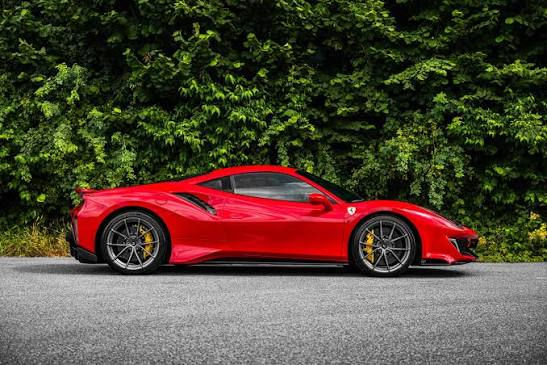
Ferrari 488 GTB and 488 Pista: Turbocharged V8 First Generation
The transition from the naturally aspirated 458 to the twin-turbocharged 488 was initially controversial among Ferrari purists but the 488's exhaust upgrade options eventually created a community of owners who are passionate about the turbocharged V8's sound potential. The factory 488 exhaust is deliberately muted to manage the slightly different acoustic character of a turbocharged engine and the aftermarket has responded with systems that transform the car's presence.
On the 488 the primary gains from a cat-back system are acoustic. The turbocharged engine does not respond to exhaust modification as dramatically in power terms as a naturally aspirated engine because the turbochargers dominate the flow management of the exhaust system. However a well-designed cat-back system with properly tuned resonators can give the 488 a sound character that is genuinely extraordinary and more expressive than the stock system. High-flow catalytic converters combined with a cat-back system and an ECU software update produce meaningful power gains on the 488 by reducing total exhaust system backpressure and allowing the turbochargers to operate at slightly higher efficiency.
Ferrari F8 Tributo and F8 Spider
The F8 uses an evolved version of the 488's twin-turbocharged 3.9-liter V8 producing 710 horsepower in standard form. The exhaust system on the F8 is more sophisticated than the 488's with active valve management that is more nuanced in its mode behavior.
Aftermarket exhaust work on the F8 requires careful attention to the valve system integration to ensure that all driving modes continue to function correctly after installation.
The Capristo valve exhaust system for the F8 is one of the most popular installations we perform. It retains the full OEM valve functionality while producing a significantly more expressive sound in Sport and Race modes. The titanium construction reduces weight and the acoustic tuning produces a sound that owners consistently describe as transformative compared to the factory system.
Ferrari Roma and Portofino M: GT Ferrari Exhaust Considerations
The Roma and Portofino M represent Ferrari's grand touring products and their exhaust upgrade landscape reflects the different priorities of these cars. GT Ferrari owners typically want an improvement in exhaust note presence without the raw aggression that suits a pure sports car. They also have a stronger preference for retaining comfort mode behavior that keeps the car genuinely quiet when required.
Exhaust upgrades on the Roma and Portofino M are primarily achieved through cat-back systems that improve the sound in Sport mode while maintaining acceptable refinement in Comfort mode. The turbocharged V8 in these cars has good sound potential that the factory system deliberately restrains to meet GT car noise expectations. A well-chosen aftermarket system unlocks that potential without making the car impractical.

Ferrari 812 Superfast and 812 Competizione: The Naturally Aspirated V12
The 812 Superfast's 6.5-liter naturally aspirated V12 is the engine that Ferrari's sound engineers consider their masterpiece. At 8500 RPM it produces a sound that no turbocharged engine at any displacement can replicate. Exhaust upgrades on the 812 are among the most rewarding installations we perform because the V12 responds so directly to exhaust system changes and the acoustic results are genuinely extraordinary.
The primary consideration for 812 exhaust work is the complexity of a V12 exhaust system. Twelve cylinders mean twelve primary pipes two exhaust banks two catalytic converter assemblies and a complex merge section before the muffler system. A full header-back system on an 812 is a significant installation project requiring full rear clam removal and careful work around the complex engine bay packaging. The acoustic and performance reward for a correct installation is commensurate with that complexity.
Akrapovic produces a titanium system for the 812 that reduces the exhaust assembly weight by over twelve kilograms compared to the OEM stainless system while producing a V12 sound character that owners consistently describe as life-changing. It is one of the most impressive exhaust transformations we have experienced on any car.
Ferrari SF90 Stradale and SF90 Spider: Hybrid Exhaust Complexity
The SF90 Stradale is Ferrari's first series production plug-in hybrid and its exhaust installation landscape is fundamentally different from any previous Ferrari. The SF90's 4.0-liter twin-turbocharged V8 shares the engine bay with a complex hybrid system including electric motors on both axles a high-voltage battery pack and a sophisticated thermal management system that integrates the engine cooling and the battery thermal management circuits.
Exhaust work on the SF90 requires specialist knowledge of hybrid vehicle architecture. The exhaust routing on this car is integrated with thermal management considerations for the hybrid components and any modification to the exhaust path must be evaluated for its effect on the thermal environment of nearby high-voltage components. This is not work for a shop that has not specifically trained on hybrid exotic vehicles. At Squadra Nostra we have the hybrid-specific training and equipment that SF90 exhaust work demands. The aftermarket options for this model are more limited than for conventional Ferrari models precisely because the engineering validation required for correct hybrid integration is more demanding.

The Premier Ferrari Exhaust Brands and What Makes Each One Different
The Ferrari exhaust aftermarket is served by a small number of manufacturers who have invested in the engineering development and acoustic testing required to produce systems worthy of these cars. Here is a genuine assessment of the leading brands we work with at Squadra Nostra.
Akrapovic
Akrapovic is the manufacturer that Ferrari's own racing division trusts for exhaust work on competition vehicles and that standing extends to the road car aftermarket products as well. Their systems for Ferrari are engineered in Slovenia with the same titanium alloy specifications and welding standards used in their MotoGP and FIA endurance racing programs.
What distinguishes Akrapovic from every other brand is the depth of acoustic development work that goes into each system. They do not simply build a freer-flowing pipe. They acoustic test extensively to ensure that the sound character produced is what the engine naturally wants to produce and that resonance frequencies that would cause driver fatigue are addressed rather than simply amplified. The result on a Ferrari is a sound that is more of what Ferrari intended rather than simply louder than what Ferrari produced. The titanium construction reduces weight significantly and the titanium surface develops a characteristic heat coloring that is visually distinctive.
Capristo
Capristo is a German manufacturer that specializes exclusively in exotic European sports car exhaust systems and they have developed deeper Ferrari-specific knowledge than perhaps any other aftermarket manufacturer. Their valve-controlled systems for Ferrari models allow owners to have meaningful quiet operation when required alongside an aggressive performance sound when desired and this dual-character capability makes Capristo the most popular choice among daily-driven Ferrari owners.
The Capristo ECE valve system integrates with the factory exhaust valve wiring harness and in some cases allows control of the exhaust valves independently of the driving mode selector through a separate remote or app. The acoustic character Capristo achieves on Ferrari V8 models is particularly well regarded: less raw and mechanical than Akrapovic and more musical and composed which suits the character of road Ferraris better in most owners' estimation.
Novitec
Novitec offers exhaust systems as part of comprehensive Ferrari performance packages and their exhaust products are most valuable when integrated with their engine tuning software. When Novitec supplies a Ferrari with both an exhaust system and an ECU tune the two elements are calibrated together so the engine management is specifically optimized for the new exhaust characteristics. This integrated approach produces better power results than an exhaust system alone and the acoustic calibration reflects the specific tuning parameters that Novitec's software applies to the engine.
Novitec's Ferrari-specific knowledge is deep because they have been developing Ferrari tuning products for over three decades and their current lineup covers virtually every Ferrari model in production. Their stainless steel systems are well priced relative to titanium alternatives and offer a good balance of performance and value for owners who want meaningful improvement without the cost of a full titanium system.
Tubi Style
Tubi Style is an Italian manufacturer with a philosophy that is deeply rooted in the Ferrari tradition. Their systems are handcrafted in Italy and characterized by an extraordinarily raw and theatrical exhaust note particularly on naturally aspirated Ferrari V12 models. If you have ever heard an older Ferrari 550 or 575 with a Tubi exhaust you understand immediately what this brand is about.
Tubi systems are not the choice for daily-driving refinement. They are the choice for owners who want to experience the absolute acoustic maximum that their Ferrari engine is capable of producing. On the 812 Superfast a Tubi system transforms the V12 into something that sounds genuinely closer to a Ferrari Formula One car than any other street-legal exhaust option. It is not subtle and it is not intended to be.
iPE (Innotech Performance Exhaust)
iPE offers valve-controlled exhaust systems for Ferrari models at a price point that is meaningfully lower than the German and Italian specialists while maintaining a sound quality and fitment standard that competes with the more expensive options. Their systems for the 488 F8 and Roma have been well received by owners who want the valve-controlled functionality of a Capristo system without the corresponding investment.
The trade-off with iPE compared to Akrapovic or Capristo is in the depth of acoustic development. The sound is good and meaningfully better than stock but it does not have the same level of frequency-specific tuning that the premium brands achieve through more extensive acoustic engineering. For an owner who is primarily interested in the performance and a solid improvement in exhaust note character without requiring the absolute best in acoustic refinement iPE represents strong value.

The Ferrari Exhaust Installation Process: What a Professional Job Looks Like
Understanding the installation process helps you evaluate whether a shop is actually doing the work correctly or taking shortcuts that will compromise the result. A professional Ferrari exhaust installation follows a specific sequence that cannot be meaningfully shortened without degrading the outcome.
Pre-Installation Diagnostic Baseline
Before any component is removed from the car a full factory-level diagnostic scan is performed. This captures all current fault codes all sensor values and all adaptive learned values stored in the engine management and transmission systems. This baseline serves two purposes. It documents the pre-installation condition of the car so that any issue discovered during installation is attributable to its actual cause rather than being confused with pre-existing conditions. It also allows the technician to verify that the car is in correct operating condition before the installation begins because an exhaust installation on an engine that already has sensor faults can produce misleading diagnostic results during the post-installation verification.
Thermal Cool-Down
Any Ferrari that has been driven recently must be given adequate time to cool before exhaust work begins. The exhaust manifolds on a V8 Ferrari operating in performance driving conditions reach temperatures above 900 degrees Celsius. The catalytic converters run even hotter during and after sustained high-load driving. Ferrari catalytic converters that have been used on track can remain hot enough to cause severe burns for over two hours after the car stops. A mandatory cool-down period of at minimum four hours and preferably overnight is enforced before exhaust work begins at Squadra Nostra regardless of what the car's owner may have driven immediately before bringing the car in.
Rear Clam or Undertray Removal
Accessing the exhaust system on a mid-engine Ferrari requires either removing the rear clam or working through significant undertray panels depending on the model. The Ferrari 458 488 and F8 mid-engine layout places the entire exhaust system in a location that is largely inaccessible without lifting the car and removing the rear diffuser and undertray panels. On models where the rear clam must be removed this is a significant task in itself requiring careful handling of the body panel and correct reinstallation to ensure panel gaps are maintained.
On the front-engine Ferrari models like the Roma 812 and Portofino exhaust access is different with the system running under the car from front to rear and accessible from beneath on a lift with undertray panels removed. The access complexity on these models is lower but the total length of the exhaust system running the full length of the car means the installation still requires careful attention to routing hangers and clearances at every point along the system.
Fastener Extraction and Condition Assessment
Removing the factory exhaust system from a Ferrari requires extracting the fasteners at each flange joint hanger point and sensor mounting. On older Ferraris or cars that have been exposed to road salt seized fasteners are a genuine challenge. Exhaust manifold studs on a Ferrari V8 are subject to enormous thermal cycling loads and they can bond to the cylinder head threads through galvanic corrosion. Extracting a seized exhaust stud without damaging the cylinder head thread requires specialist techniques including penetrating lubricant application controlled heat application with a thermal lance and sometimes stud extraction tooling.
Each fastener extracted is assessed for reuse or replacement. Stretched studs and corroded nuts are always replaced with new hardware. On a Ferrari exhaust installation using compromised fasteners is never acceptable because the thermal cycling loads on these joints are high and an undertightened or compromised fastener will fail under service conditions.
Sensor and Valve System Transfer
The oxygen sensors pre and post catalytic converter must be removed from the factory exhaust system and transferred to the new system in the correct locations. On turbocharged Ferrari models the oxygen sensor placement relative to the turbocharger outlets is particularly important for correct fuel system feedback and any aftermarket system that places the sensors in a significantly different location from the factory position may require ECU adaptation to maintain correct fueling.
The active exhaust valve actuators are removed from the factory muffler assembly and installed on the aftermarket system. This requires connecting the actuator wiring harnesses to the appropriate connectors on the aftermarket system and verifying that the actuator travel matches what the factory ECU expects to see when it commands valve open and valve closed positions. A valve actuator that is not correctly integrated will trigger a fault code and may limit the car's performance modes or produce persistent warning lights.
New System Fitment and Alignment
The aftermarket exhaust system is offered up to the car dry before final installation to verify fitment and check clearances to all surrounding components. On a Ferrari the exhaust system routes in close proximity to suspension components aerodynamic underbody panels and in the case of mid-engine models the rear subframe and drivetrain components. Any interference must be identified and resolved at this stage rather than after the system is bolted in place.
Hanger positioning is checked and adjusted to ensure the system is correctly suspended without transferring exhaust vibration to the chassis. Each hanger rubber mount is inspected and replaced if it shows any cracking or degradation. An incorrectly hung exhaust system on a Ferrari will vibrate against chassis components and create rattles that are disproportionately amplified through the rigid aluminum or carbon fiber structure of these cars.
Final Torque and Leak Check
All flanges are torqued to the specified values using a calibrated torque wrench. The exhaust system on a Ferrari is a high-temperature environment and fastener torque specification must be followed precisely because both under-torquing and over-torquing create leak and failure risks. Under-torqued flange joints will develop leaks as the exhaust system heats and the metal expands. Over-torqued studs can stretch past their yield point and lose clamping load or snap during thermal cycling.
The engine is then started from cold and the entire exhaust system is monitored carefully for any leaks at flanges joints and sensor ports. Leaks in the exhaust system upstream of the oxygen sensors will introduce false air into the exhaust stream that the lambda sensors read as excess oxygen causing the ECU to add fuel to compensate which increases fuel consumption and reduces performance. Leaks anywhere in the system can direct hot exhaust gas toward components that are not designed to receive it. The technician checks every joint by sound and by holding a hand near each interface to detect heat escaping from any gap.
Post-Installation Diagnostic Scan and Road Test
After the first heat cycle a diagnostic scan is performed to verify that no new fault codes have been generated and that all oxygen sensor values are reading correctly. The car is then road tested across a range of driving modes and RPM ranges. Each driving mode is tested to verify that the valve system is operating correctly and that the sound character in each mode matches the expected result. Any mode that is not functioning correctly is diagnosed and addressed before the car is released.
The road test also evaluates whether the new exhaust system has introduced any vibration or drone at specific RPM ranges that was not present before installation. A small adjustment to hanger positioning or the addition of a vibration isolator at a specific mount point can address minor resonance issues that only become apparent once the system is on the car and tested under real conditions.
Honest Assessment: What a Ferrari Exhaust Installation Actually Delivers
Too many exhaust discussions focus on exaggerated power claims. Here is an honest breakdown of what you actually get from a Ferrari exhaust upgrade across each category.
Sound: The Primary Transformation
The most significant and immediate result of a quality Ferrari exhaust installation is the transformation of the car's acoustic character. This is not a subjective matter of taste in the sense that some people will notice it and some will not. Everyone will notice it. The question is whether the change is an improvement and for well-designed systems installed on the right Ferrari model the answer is yes in a way that fundamentally changes how you experience the car.
A Ferrari 812 Superfast with an Akrapovic titanium system sounds in the upper RPM range like something that should not be legal on a public road in the most extraordinary possible sense. A Ferrari 458 with a Capristo cat-back produces an induction and exhaust note that you will drive far out of your way to experience in tunnels. A Ferrari F8 with high-flow cats and a quality mid-section produces turbocharger sounds alongside the V8 note that reward spirited driving with an acoustic experience that the stock system deliberately suppresses. These are genuine improvements to the ownership experience not placebo effects.
Power: Realistic Expectations by Engine Type
On naturally aspirated Ferrari engines like the 458's V8 and the 812's V12 a cat-back exhaust system alone will produce modest power gains in the five to fifteen horsepower range primarily in the upper RPM band where exhaust scavenging is most active. A full header-back system with ECU optimization can produce gains of fifteen to thirty-five horsepower on these engines which on a naturally aspirated platform represents a meaningful percentage increase.
On turbocharged Ferrari engines the power gain from exhaust modification is more dependent on accompanying ECU calibration. The turbocharged V8 in the 488 F8 or Roma is managed by an engine control system that maintains boost pressure within calibrated limits regardless of exhaust backpressure changes. A cat-back system without ECU tuning on a turbocharged Ferrari produces minimal power gain. High-flow catalytic converters combined with ECU software that recalibrates fueling and boost management can produce gains of thirty to sixty horsepower on these engines because the software allows the turbochargers to operate at slightly higher efficiency and the engine management to optimize ignition timing for the new exhaust characteristic.
Weight Reduction
A full titanium exhaust system on a Ferrari can reduce the total exhaust assembly weight by eight to fifteen kilograms depending on the model and the system. On a 1400 kilogram Ferrari this represents approximately one percent of total vehicle weight removed from a location at the rear of the car which has a small but measurable effect on front-rear weight distribution as well as reducing overall inertia. Weight reduction from an exhaust upgrade is a genuine engineering benefit even if it is secondary to the acoustic and performance gains for most owners.
The Valve System Enhancement
Many aftermarket systems for current Ferrari models provide enhanced valve control flexibility compared to the factory setup. The Capristo ECE system for example allows the exhaust valves to be held open even in Comfort mode using a remote control. This gives the owner mode-independent control of the exhaust character rather than being tied to whatever valve position the driving mode selector dictates. This functionality is genuinely useful for owners who want to drive spiritedly on an open road while keeping the suspension and throttle mapping in a less aggressive mode.
Ferrari Exhaust Installation Cost Guide: Miami Market Pricing
The following ranges reflect professional specialist pricing for Ferrari exhaust installation in the Miami area. These are not dealership prices which are typically sixty to ninety percent higher for equivalent quality work. All pricing below covers both parts and professional installation labor at Squadra Nostra.
SERVICE | ENTRY RANGE | HIGH-SPEC RANGE |
458 / 458 Speciale cat-back install | $3,500 to $5,500 | $6,500 to $9,500 |
488 GTB / GTB Pista cat-back install | $3,800 to $5,800 | $6,800 to $10,000 |
F8 Tributo / F8 Spider cat-back install | $4,000 to $6,500 | $7,500 to $11,500 |
Roma / Portofino M cat-back install | $3,500 to $5,500 | $6,000 to $9,500 |
812 Superfast cat-back install | $5,500 to $8,500 | $9,500 to $15,000 |
812 Competizione cat-back install | $6,000 to $9,000 | $10,000 to $16,000 |
High-flow catalytic converter upgrade (pair) | $2,200 to $3,500 | $3,500 to $6,000 |
Full header-back system (V8 models) | $8,500 to $14,000 | $14,000 to $22,000 |
Full header-back system (V12 812) | $12,000 to $20,000 | $20,000 to $35,000 |
Active valve integration (ECE/Capristo) | $800 to $1,400 | $1,400 to $2,500 |
ECU calibration post exhaust install | $1,200 to $2,000 | $2,000 to $4,000 |
SF90 Stradale exhaust consultation | By assessment | By assessment |
Pricing above includes parts and installation labor. Final cost depends on exact model variant condition and scope revealed during installation. A confirmed written estimate is provided before any work begins.
Frequently Asked Questions: Ferrari Exhaust Installation
Will an aftermarket exhaust void my Ferrari warranty?
In the United States the Magnuson-Moss Warranty Act provides meaningful protection for owners who install aftermarket components. A manufacturer cannot void your warranty simply because you have installed an aftermarket exhaust system. They must demonstrate that the aftermarket component directly caused the specific issue that is the subject of the warranty claim. In practice this means that if you install an aftermarket cat-back system and subsequently bring the car in for a warranty claim about an unrelated issue such as an electronics fault the dealer cannot refuse that claim because of the exhaust. Where it gets more complex is if you have also had an ECU tune performed. A tune that modifies engine management parameters could plausibly be related to an engine warranty claim and dealerships take a harder line in those situations. For owners who want to maintain full warranty coverage and still improve the exhaust note a valve-only or cat-back system without ECU tuning is the most defensible approach.
Can I keep my stock exhaust and have it reinstalled if needed?
Yes. We recommend all clients keep their factory exhaust systems stored safely after an upgrade. The factory system should be kept with all its hardware including gaskets flanges and mounting hardware so it can be reinstalled cleanly if required. Common reasons to reinstall the factory exhaust include pre-warranty service visits where the owner prefers not to have the modification on record at a dealership pre-sale preparation for buyers who prefer factory specification and occasional relocation to a state or country where aftermarket exhaust regulations are more restrictive. We can reinstall a factory system quickly and cleanly and return the car to exactly its original specification.
How long does a Ferrari exhaust installation take?
A cat-back installation on most Ferrari models takes between four and six hours in skilled hands. A full header-back installation that requires rear clam removal on a mid-engine Ferrari takes eight to twelve hours and may extend to a full two-day project on more complex models. Active valve integration and post-installation diagnostic work and road testing are included in these estimates. We never rush Ferrari exhaust installations because the consequences of a rushed installation include leaks incorrect sensor placement and valve system faults that require significantly more time to diagnose and correct than doing the job properly in the first place.
My Ferrari is the European specification model. Are there different exhaust options available?
European-specification Ferrari models are subject to EU type approval regulations that in some cases restrict the aftermarket exhaust options that can be legally used on public roads. Many Akrapovic and Capristo systems are available in both a street-legal ECE-approved version and a race version that does not carry type approval. In the United States the regulatory picture is different and determined primarily by your state's emissions testing requirements. Florida does not currently require emissions testing for vehicles over a certain age which gives Florida-registered Ferrari owners more flexibility than owners in California or states that follow California emissions standards. We will advise you specifically on the regulatory situation for your car before any work is specified.
What maintenance does an aftermarket exhaust system require?
A quality stainless or titanium aftermarket exhaust system requires minimal maintenance. The primary maintenance consideration is periodic inspection of the mounting hardware to ensure that the fasteners at each flange and hanger point have not loosened due to thermal cycling. On a car that is used on track or that sees frequent high-RPM use we recommend an inspection of all exhaust fastener torque at the annual service interval. Titanium exhaust systems should not be cleaned with abrasive products that can scratch the titanium surface. A mild soap and water clean with a microfiber cloth is sufficient to maintain the appearance of the tips and visible sections. The heat coloring that develops on titanium components over time is a natural characteristic of the material and many owners consider it part of the system's visual character.
Can Squadra Nostra come to my location for a Ferrari exhaust installation?
Mobile exhaust installation is available for most cat-back system installations on Ferrari models. We bring professional-grade equipment diagnostic tools and the correct lifting and support equipment to your location across Miami and South Florida. Header-back installations that require rear clam removal or extensive under-car access are best performed with full workshop lift access and we can coordinate appropriate arrangements for these more complex jobs. Contact us to discuss the specific requirements for your model and preferred location.
The Right Exhaust on the Right Ferrari Changes Everything
Ferrari engineers spend years developing the acoustic signature of every car they build. The exhaust note is not a byproduct of the engine's combustion process. It is engineered deliberately to communicate the car's performance character to the driver and to everyone nearby. When that system is upgraded by people who understand what Ferrari was trying to achieve and who have the technical knowledge and equipment to do the work correctly the result is not a modification. It is an enhancement of what the car was always trying to be.
At Squadra Nostra we have been working on Ferrari exhaust systems long enough to know which systems work on which models and why. We know the fasteners that seize on the older cars and how to extract them without damage. We know which valve integration approaches work cleanly and which create ongoing fault codes. We know how to read the post-installation diagnostic data to confirm that the oxygen sensors and the valve actuators are behaving exactly as they should. And we know what a correctly installed premium exhaust system sounds like on every Ferrari model we work on because we have heard it dozens of times.
If you are a Ferrari owner in Miami who is considering an exhaust upgrade we would welcome the conversation. Contact Squadra Nostra and we will discuss your specific car your goals and the system that will deliver the result you are looking for.


Comments