


Porsche GT3: The Deep Owner Guide to the Purest Sports Car
Porsche GT3 is a name that means something specific to people who love driving. It is not the fastest car in a straight line, not the most expensive Porsche and not the flashiest thing on Ocean Drive. What it is, is the purest driving experience Porsche sells, and for a certain kind of owner nothing else comes close.
The GT3 sits at the point where a road car and a race car meet. It has a naturally aspirated engine that revs to the sky, a chassis developed on the hardest track in the world, and an honesty that turbo supercars have quietly lost. It talks to you. It rewards skill. It never feels numb.
We are Squadra Nostra. We look after exotic and performance cars across Miami-Dade and Broward County, and we come to you. This guide is a deep, honest look at the GT3. What makes it special, how to buy a good one, how to live with it in Miami and how to keep it healthy and valuable for years.
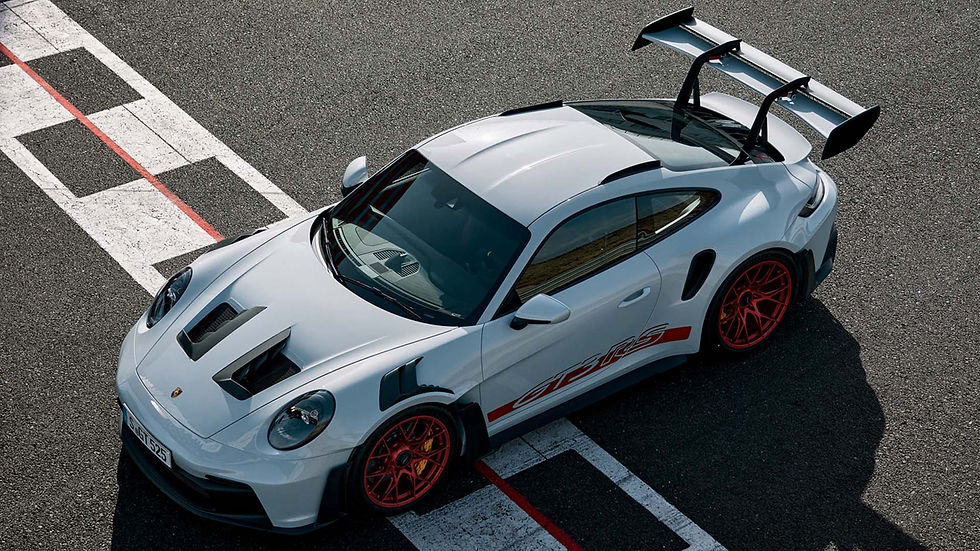
Table of Contents
1. What Makes the Porsche GT3 Different From Every Other 911
Porsche sells a lot of 911 models and most of them are brilliant. So the first honest question is what actually separates the GT3 from a Carrera S or a Turbo. The answer is not just more power. It is a completely different philosophy.
A normal 911 is built to be fast, comfortable and usable every day. The GT3 is built to be the best possible driving tool first, and everything else comes second. It uses a different engine, a different chassis, different aerodynamics and a different mindset. It shares a shape with the other 911s and very little else that matters.
The clearest difference is the engine. Most modern 911 models are turbocharged, even the ones not called Turbo. The GT3 keeps a naturally aspirated engine that breathes on its own and revs far higher than any turbo car. That single choice is the heart of what the GT3 is, and it is becoming rarer every year.
Squadra Nostra Perspective We service a lot of fast cars, and the GT3 owner is a specific person. They are not chasing the biggest number. They have usually owned quicker cars and sold them, because quick got boring. The GT3 is the car people buy when they have figured out what they actually want from driving. It rarely gets sold for being disappointing. |
2. The GT Department and Why It Matters
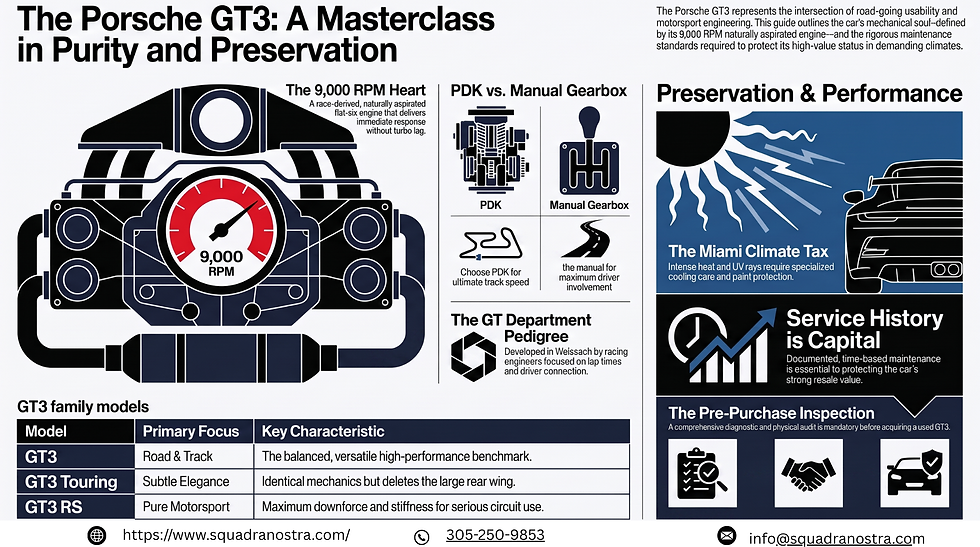
The GT3 is not built by the same team that builds a normal 911. It comes from a special group inside Porsche known as the GT department, based in Weissach. This is the same group responsible for Porsche's racing cars and their most focused road machines.
This matters because it means the GT3 is developed by people whose job is lap time and driver connection, not comfort and sales volume. They tune the engine, the chassis and the aerodynamics with a racer's mindset. The result is a car that feels engineered by enthusiasts rather than by a committee.
It also explains why the GT3 holds together as a complete car. Every part was chosen to serve the same goal. The engine, the gearbox, the suspension and the aero all pull in one direction. That coherence is something you feel the first time you drive one hard, and it is very hard to fake with aftermarket parts on a lesser car.
3. The Naturally Aspirated Flat Six
The heart of the GT3 is a naturally aspirated flat six engine mounted behind the rear axle. Flat means the cylinders lie horizontally, three on each side, instead of standing in a V or a line. This layout sits low in the car, which lowers the center of gravity and helps handling.
Naturally aspirated means there is no turbocharger. The engine breathes air on its own through the throttle. This is the single most important thing about the GT3 and it is why the car feels the way it does. There is no turbo lag, no waiting, no soft spot. You press the pedal and the engine responds that instant.
It also means the engine makes its power high in the rev range. A turbo engine shoves you forward low down and then flattens out. The GT3 engine builds and builds as the revs climb, pulling hardest right near the top. This rewards you for revving it out, which is exactly what a driver's car should do.
Expert Note: This Engine Is Becoming Extinct High revving naturally aspirated engines are disappearing from the car world because of emissions rules and the move to turbos and electric power. The GT3 is one of the last places you can buy a brand new one. That is a big part of why these cars are so loved and why values stay strong. You are buying a piece of engineering that may not exist much longer. |
4. 9,000 RPM and Why It Still Exists
The newest GT3 engines rev to around 9,000 rpm. To put that in context, most normal cars run out of revs around 6,000 or 6,500. Very few road cars in history have ever revved this high, and almost none of them are still in production today.
That number is not just a bragging point. High revs are where the sound and the drama live. As the engine spins faster, the exhaust pulses arrive quicker and blend into that famous howl. A GT3 at full revs makes a sound that no turbo car can match, because the turbos on those cars swallow exactly those high frequencies.
Reaching this rev ceiling takes serious engineering. The engine uses race derived parts and light components that can survive spinning this hard, thousands of times, for years. This is why the GT3 engine traces its design back to Porsche's motorsport work rather than to the normal 911 engine range.

Expert Note: Let It Rev, That Is the Point New GT3 owners often short shift out of habit from normal cars, changing gear at 5,000 and missing the entire experience. The magic on this engine lives in the top third of the rev range. If you never take it past 6,000 you have bought the wrong car. Warm it up properly, then use the revs it was built to give you. |
5. PDK vs Manual: The Honest Answer
This is the biggest decision a GT3 buyer faces and the internet argues about it endlessly. Here is the honest version, without taking a side, because the right answer depends entirely on you.
PDK
PDK is Porsche's dual clutch automatic. It shifts faster than any human can, it never misses a gear and it is the choice for outright lap time. On track it is simply better. Around town it makes the car easier to live with. If your priority is speed and usability, PDK is the rational answer and it is superb.
Manual
Porsche brought the manual back to the GT3 after owners demanded it. It is slower on paper and it will lose a lap time to PDK every time. But it involves you completely. You are working with the car, not just steering it. For many owners that connection is the entire reason they bought a GT3 in the first place.
Factor | PDK | Manual |
Lap time | Faster | Slower |
Daily traffic | Easier | More work |
Driver involvement | Less | Complete |
Resale demand | Strong | Often stronger |
Best for | Track and speed | Feel and connection |
Here is the practical truth. If you track the car seriously and want the fastest tool, choose PDK. If the GT3 is your weekend joy and you love the act of driving, the manual will make you smile more. Neither is wrong. Both are excellent. Buy the one that matches how you will actually use the car.
6. The Chassis, Aero and Rear Steering
The engine gets the attention but the chassis is where the GT3 earns its reputation. This is a car developed to lap the Nurburgring, the most demanding track in the world, and everything about how it holds the road comes from that work.
The Suspension
The GT3 uses a firmer, more focused suspension setup than a normal 911, with more adjustment for people who track the car. It is stiff, but it is controlled rather than harsh. The car stays flat, turns in sharply and tells you exactly what the tires are doing at all times. That feedback is the whole point.
The Aerodynamics
The large rear wing and front aero are not just for looks. They press the car onto the road at speed, which is called downforce. More downforce means more grip in fast corners. Newer GT3 models use serious aero developed with real motorsport knowledge, and it genuinely changes how the car behaves at pace.
Rear Wheel Steering
Newer GT3 models steer the rear wheels a small amount as well as the front. At low speed the rear wheels turn the opposite way to make the car more agile. At high speed they turn the same way to make it more stable. You never feel it working directly, but the car feels both sharper and safer because of it.
Miami Note: A Firm Car on Real Roads The GT3 is firm, and some Miami roads are rough. This is not a soft grand tourer. If you are coming from a comfortable car, know that the GT3 trades some ride comfort for feedback and control. Most owners stop noticing within a week because the car gives back so much. But go in with clear expectations. |
7. GT3 vs GT3 Touring
Porsche offers the GT3 in two looks. The standard GT3 with the large rear wing, and the GT3 Touring which deletes the big wing for a cleaner, more subtle shape. Mechanically they are essentially the same car. The choice is about how loud you want the car to be about what it is.
The standard car with the wing looks like what it is, a road going race car, and it wears that proudly. The Touring looks like an elegant fast 911 that hides its abilities. Under the skin you get the same engine, the same chassis and the same experience. The wing changes high speed downforce, but on the street you will rarely notice.
For a long time the Touring was offered only with the manual gearbox, which made it the purist's choice. That has changed on newer cars. Which one you want comes down to taste. Do you want the car to shout or whisper. Both drive the same and both are wonderful. There is no wrong answer here.

8. GT3 vs GT3 RS
Above the GT3 sits the GT3 RS, which stands for RennSport, meaning racing sport. Owners often ask which one they should buy, so here is the honest comparison. The RS is more extreme in every way, and that is both its strength and its limit.
The RS has more aggressive aero, more downforce, a stiffer setup and a stronger track focus. On a circuit it is faster and more capable. It is a car built primarily to lap hard, with the road as a secondary consideration. It is louder, firmer and more single minded about its purpose.
The plain GT3 is the more usable car. It is still track capable, still thrilling, but it works far better as a car you can actually drive on the road often. For most owners who are not living at the track, the GT3 is the smarter buy. The RS is for those who genuinely use the extra capability.
Expert Note: Be Honest About How You Drive The RS is the more exciting car to talk about and the GT3 is the more rewarding car to own for most people. Unless you do real track days often, the extra stiffness and noise of the RS become a tax you pay every day for capability you rarely use. Buy the RS because you track hard, not because it sounds cooler at dinner. |
9. Generation Guide: 996 to 992
The GT3 has been through several generations since 1999, each with its own character. Knowing them helps you understand the used market and pick the right one for you.
996 GT3
The original, from around 1999. It is raw, analog and increasingly collectible as the first of the breed. It uses an engine derived from Porsche's racing and endurance work. For collectors it is a landmark car. For drivers it is pure and old school.
997 GT3
Many enthusiasts consider the 997 the sweet spot. It is modern enough to live with, old enough to feel analog and connected, and it came only with a manual gearbox. Later 997 versions raised the game further. Values reflect how loved this generation is.
991 GT3
The 991 brought PDK and, on later cars, brought the manual back after owner demand. It also introduced rear wheel steering. This generation modernized the GT3 while keeping its soul, and the later 991.2 cars are widely seen as some of the best all round GT3 models ever made.
992 GT3
The current car. It uses a double wishbone front suspension derived from the race cars, revised aero and a naturally aspirated flat six revving to around 9,000 rpm. It is the most capable GT3 yet while keeping the naturally aspirated heart that defines the whole line.
Reality Check: There Is No Bad GT3 People agonize over which generation is best. The honest truth is that every GT3 is a special car and you will love whichever one you buy. Newer cars are faster and easier to live with. Older cars are rawer and more analog. It is a question of character and budget, not good versus bad. They are all genuinely great. |
10. Buying a Used GT3: What to Check
Most people buy their GT3 used, and a used GT3 needs more care than a normal used car. These are high performance machines that some owners track hard. A good one is a joy. A neglected or abused one can be a very expensive mistake. Here is what matters.
History and Service Records
A complete service history is the first thing to demand. You want to see that the car was maintained properly and on time. Gaps in the record raise questions, and on a car like this those questions can be expensive to answer. A well documented car is worth paying more for.
Track Use
Track use is not automatically bad. A car tracked by a careful owner who maintained it well can be perfectly healthy. But hard track use with poor maintenance wears an engine, brakes and clutch far faster than road miles. You need to know the history honestly, not guess.
Accident and Paint
Check for accident history and repainted panels. A GT3 that has been crashed and repaired needs careful inspection to confirm it was done right. Paint that does not match or panels that fit poorly are warning signs worth taking seriously on a car at this price.
Originality
On a collectible car, originality carries real value. Check whether the car is standard or modified, and whether the factory parts came with it. A modified GT3 is not automatically worth less, but a car that can return to standard specification is easier to sell and usually worth more.
11. The Pre-Purchase Inspection
If you are buying a used GT3, a pre-purchase inspection is not optional. It is the smartest money you will spend in the whole process. A used high performance Porsche can hide costly issues that a short test drive will never reveal. We inspect the car fully before you commit a dollar.
What a GT3 Inspection Should Cover
● A full diagnostic scan for stored and pending fault codes.
● Engine health, including any signs of hard track abuse.
● Clutch and gearbox condition, especially on manual cars.
● Brake and tire wear, and evidence of the car's real use.
● Suspension condition and any signs of accident repair.
● A careful review of the service history against the car.
A clean inspection lets you buy with confidence. A bad one saves you from a car that would drain your account. Either way you make the decision with real facts instead of a seller story. We give you photo and video proof so you decide on evidence, not hope.
Why Mobile Helps Here We come to the car, wherever it is. That means we can inspect a GT3 at a dealer or a private seller before you travel or wire money. For a car this valuable, having an independent expert look at it in person, on your behalf, before you commit, is one of the best decisions you can make. |

12. Living With a GT3 Every Day
People assume a GT3 is too hardcore to use often. That is only half true. It is firmer and louder than a normal 911, but it is still a Porsche, which means it is genuinely usable in a way most exotics are not. Many owners drive theirs regularly and love it for that.
The ride is firm but livable. The cabin is a real 911 cabin with real seats and real air conditioning. Visibility is good. It starts every time and it does not overheat in traffic the way a mid engine exotic can. As a car you can actually use, it is far more practical than its looks suggest.
The honest trade offs are noise, ride firmness and low ground clearance at the front. On rough roads and steep driveways you drive with care. But these are small prices for what the car gives back. Most owners find the GT3 far easier to live with than they expected, which is part of its genius.
13. Owning a GT3 in Miami
Miami is a wonderful place to own a GT3 and a demanding one. The weather lets you drive year round, the roads and causeways are made for it, and the community of enthusiasts here is real. But the climate works against the car in specific ways you need to manage.
Heat
A high performance engine makes a lot of heat and Miami adds high ambient temperatures on top. The GT3 handles it well because Porsche engineers thoroughly, but staying on top of cooling health matters more here than in a mild climate. This is not a car to neglect the cooling system on.
Sun
Intense Miami sun fades interiors and attacks paint over time. A GT3 has expensive paint and often special interior materials. Protecting it from the sun with careful storage, film and coatings is not vanity here. It is how you keep the car looking and feeling new in a harsh environment.
Low Front and Rough Roads
The GT3 sits low at the front and some Miami roads and driveways are unkind to it. A front lift system, if the car has one, is a real help. Without it, you learn every steep entrance in your life and approach them at an angle. The expensive front bodywork makes this worth taking seriously.
Miami Note: Store It Properly Many GT3s in Miami live in garages and come out on weekends. A car that sits needs care. Keep the battery healthy with a proper conditioner, keep the tires from developing flat spots, and keep the car protected from heat and humidity. A GT3 that is stored well starts and drives perfectly every weekend. One that is neglected does not. |
14. Service and Maintenance
A GT3 needs proper maintenance and it rewards it. Porsche builds these engines to be durable, but they are highly strung machines that live at high revs, and they need the right care to stay healthy. This is not a car to skip services on to save money.
The basics matter more here than on a normal car. Fresh oil is vital on an engine that revs this hard and runs this hot. Brake fluid must be changed on time because old fluid fades under hard use, which is a real safety issue. Coolant, filters and the small items all need doing on schedule.
These cars often cover low miles, which fools owners into thinking they can skip service. That is a costly myth. Oil, brake fluid and coolant age with time, not just miles. The annual service protects the car and it protects the service history that any future buyer will want to see. Time based service is not optional.
Expert Note: The Service History Is Money On a GT3, the service history is not just paperwork. It is a real part of the car's value. A complete, unbroken record from someone who knew the car makes it worth more and easier to sell. A gap in the history is a red flag to every serious buyer. Every service done properly and documented protects your investment. |
15. Taking It to the Track
The GT3 was built for the track and using it there is one of the great joys of ownership. But a track day asks far more of the car than a road drive, and preparation is what keeps both you and the car safe. Showing up unprepared is how good days go wrong.
Before a track day the priorities are simple. Fresh brake fluid, because it will fade otherwise under repeated hard braking. Good tires with life in them. A full health check so nothing fails when you are pushing. And correct fluid levels, because the car will be working far harder than it ever does on the road.
The GT3 is genuinely track capable out of the box, which is rare. You do not need to modify it to enjoy a circuit. What you need is to prepare it properly, drive within your growing ability, and maintain it between events. A well prepared GT3 is one of the most rewarding track cars money can buy.
Reality Check: Preparation Beats Modification New track owners want to buy parts. What actually makes you faster and safer is fresh fluid, good tires, a healthy car and seat time. The GT3 is already a brilliant track car. Prepare it correctly and learn to drive it well before you spend a dollar on modifications. The car is not the limit. You are, and that is a good thing. |
16. Tires, Brakes and Consumables
A GT3 costs more to run than a normal car and being honest about that helps you enjoy it without stress. These are the ongoing costs that come with a high performance machine, and none of them should surprise you if you go in informed.
Tires
The GT3 runs high performance tires that wear faster than normal car tires, especially if you drive it the way it wants to be driven. They also age out. A tire can look fine and be unsafe once it is too old, which matters on low mileage cars that sit. Check age, not just tread.
Brakes
Many GT3 models offer carbon ceramic brakes, which are superb and long lasting but very expensive to replace when the day comes. Steel brakes are cheaper to service and perfectly good for road and light track use. Know which your car has and budget accordingly, because ceramics are a serious cost.
Clutch
On manual cars the clutch is a wear item and hard use shortens its life. On PDK cars the dual clutch is durable but not immortal. Either way, how the car was driven by previous owners affects how much life is left, which is exactly why the inspection matters so much.

17. Protecting the Car and Its Value
A GT3 is both a thrill and an investment, and protecting it protects both. In Miami especially, the right protection keeps the car looking new and holds its value. Here is how the main options compare for a car like this.
Protection | What It Does | Value in Miami | Reversible |
Paint protection film | Stops chips and road rash | Very high | Yes |
Ceramic coating | UV protection, easier cleaning | High | N/A |
Proper storage | Battery, tires, climate | Essential | N/A |
Full service history | Documents care | Essential | N/A |
Keep it original | Protects collectibility | High | N/A |
The front of a GT3 takes stone chips and road rash, so paint protection film on the front is one of the best investments you can make here. Add a ceramic coating for UV protection and easier cleaning in our sun. Store it properly. Keep every service documented. Those simple things protect a valuable car.
18. The GT3 as an Investment
Let us be honest about something owners think about even if they do not say it out loud. The GT3 has been one of the strongest holding performance cars of its era. Well kept examples have often held or grown in value in a way that most cars simply do not.
The reasons are real. These cars are built in limited numbers by a special department. They use a naturally aspirated engine that is becoming extinct. They are genuinely loved by people who understand cars. And demand consistently outstrips supply for good examples. That combination supports strong values over time.
But do not buy a GT3 purely as an investment. Buy it because you love it and want to drive it, and let the strong values be a bonus. What protects the value is exactly what makes ownership good anyway. Careful maintenance, complete history, honest mileage, proper protection and originality. Look after the car and the car looks after your money.
Warning: Condition and History Are Everything Two GT3s of the same year and model can be worth very different money. The difference is condition, history, originality and honesty. A car with a complete record, no stories and careful ownership commands a real premium. A car with gaps, questions and neglect sits on the market. How you own the car directly decides what it is worth. |
19. How Squadra Nostra Looks After Your GT3
We treat the GT3 with the respect it deserves. We are mobile across Miami-Dade and Broward County and we work to OEM and manufacturer correct standards. Whether you are buying one, maintaining one or preparing one for the track, we handle it the way this car should be handled.
For buyers, we do thorough pre-purchase inspections so you know exactly what you are getting before you commit. For owners, we handle service on time and to the correct standard, and we document everything to protect your history file. For track drivers, we prepare the car so nothing fails when you are pushing.
Our team carries more than 15 years of combined work on Porsche and other performance and exotic brands. We understand naturally aspirated engines, we understand what these cars are worth, and we understand what Miami does to them. To us a GT3 is not just another car. It is one of the ones we most enjoy looking after.

What You Get With Us
● Thorough pre-purchase inspections with photo and video proof.
● Service done on time and to the correct standard.
● Full documentation that protects your service history and value.
● Track preparation that keeps you and the car safe.
● Honest advice on protection, storage and originality.
● Fully mobile service at your home, office or garage.
Ready When You Are Call 305-250-9853 or email info@squadranostra.com. We are open Monday to Friday from 8 AM to 8 PM and Saturday to Sunday from 10 AM to 6 PM. Whether you are buying, servicing or tracking a GT3, tell us what you need and we will look after the car properly. |
20. Closing Thoughts
The Porsche GT3 is one of the last honest sports cars in a world that is quietly losing them. A naturally aspirated engine that revs to the sky. A chassis born on the hardest track in the world. A driving experience that talks to you and rewards skill instead of hiding behind technology. There is very little else like it left.
If you are buying one, buy on condition and history, not just on price. Get a proper inspection. Choose PDK or manual based on how you actually drive, not on what a forum told you. Then look after it. Service it on time even on low miles. Protect it from the Miami sun and roads. Keep it original if you can.
Do that and you get a car that thrills you every single time you drive it, that holds its value in a way few cars do, and that you may never want to sell. The GT3 is not the fastest or the flashiest car you can buy. It is one of the best, and for the right owner that is worth far more.
Frequently Asked Questions
These are the questions Porsche owners in Miami ask us most about the GT3.
FAQ 1: What makes the GT3 different from a normal 911?
A completely different philosophy, not just more power. It comes from Porsche's special GT department, it keeps a naturally aspirated engine that revs far higher than the turbo 911 models, and its chassis and aero were developed for the track. It shares a shape with other 911s and very little else that matters to a driver.
FAQ 2: Should I buy the PDK or the manual GT3?
It depends on how you drive. PDK shifts faster, is quicker on track and is easier in traffic. The manual is slower on paper but involves you completely, which is why many owners love it. If you track seriously, choose PDK. If the car is your weekend joy, the manual will make you smile more. Neither is wrong.
FAQ 3: Is the GT3 or the GT3 RS better for me?
For most owners, the plain GT3. The RS is more extreme, more track focused, louder and firmer, and it is genuinely faster on a circuit. But unless you do real track days often, that extra capability becomes a daily tax you rarely use. Buy the RS because you track hard, not because it sounds cooler.
FAQ 4: Why does the GT3 rev to 9,000 rpm?
Because it is naturally aspirated and built with race derived engineering. High revs are where the sound and the drama live, as the exhaust pulses blend into that famous howl. Very few road cars have ever revved this high, and almost none still in production do. It is one of the last of its kind, which is a big part of the appeal.
FAQ 5: Is a GT3 hard to live with every day?
Less than you would expect. It is firmer and louder than a normal 911, but it is still a Porsche, so it is genuinely usable. Real seats, real air conditioning, good visibility, starts every time and does not overheat in traffic. The trade offs are ride firmness, noise and a low front. Most owners adapt within a week.
FAQ 6: Should I get a pre-purchase inspection?
Absolutely, without exception. A used GT3 can hide costly issues a test drive will never reveal, and some were tracked hard. We check the engine, the gearbox and clutch, the brakes and tires, signs of accident repair and the full service history. We give you photo and video proof so you buy on facts, not a seller story.
FAQ 7: Is track use bad on a used GT3?
Not automatically. A car tracked by a careful owner who maintained it properly can be perfectly healthy, because the GT3 was built for the track. What hurts is hard track use combined with poor maintenance, which wears the engine, brakes and clutch fast. You need to know the real history, which is why the inspection matters.
FAQ 8: Does the GT3 hold its value?
It has been one of the strongest holding performance cars of its era. Limited production, a special department, a naturally aspirated engine that is becoming extinct, and demand that outstrips supply all support strong values. But buy it because you love it and let the value be a bonus. Condition and history decide what any individual car is worth.
FAQ 9: How much does it cost to run a GT3?
More than a normal car. High performance tires wear faster and age out, carbon ceramic brakes are expensive when they finally need replacing, and the clutch is a wear item affected by how the car was driven. Service on time is essential. None of it should surprise you if you go in informed and budget properly.
FAQ 10: Do I need to service it if I barely drive it?
Yes. Low miles fool owners into skipping service, but oil, brake fluid and coolant age with time, not just miles. The annual service protects the car and protects the service history that any future buyer will demand. Time based service is not optional on a car like this, no matter how few miles you cover.
FAQ 11: What should I do to own a GT3 well in Miami?
Manage the heat with proper cooling care, protect the paint and interior from the intense sun with film and coatings, use a front lift if the car has one for our low driveways, and store it properly with a battery conditioner if it sits. The climate is hard on the car, but good care keeps it perfect.
FAQ 12: Can you inspect or service a GT3 at my location?
Yes. We are fully mobile across Miami-Dade and Broward County. We can inspect a car at a dealer or private seller before you commit, and we service and prepare cars at your home, office or garage. For a car this valuable, having an independent expert come to you is a real advantage.


Comments